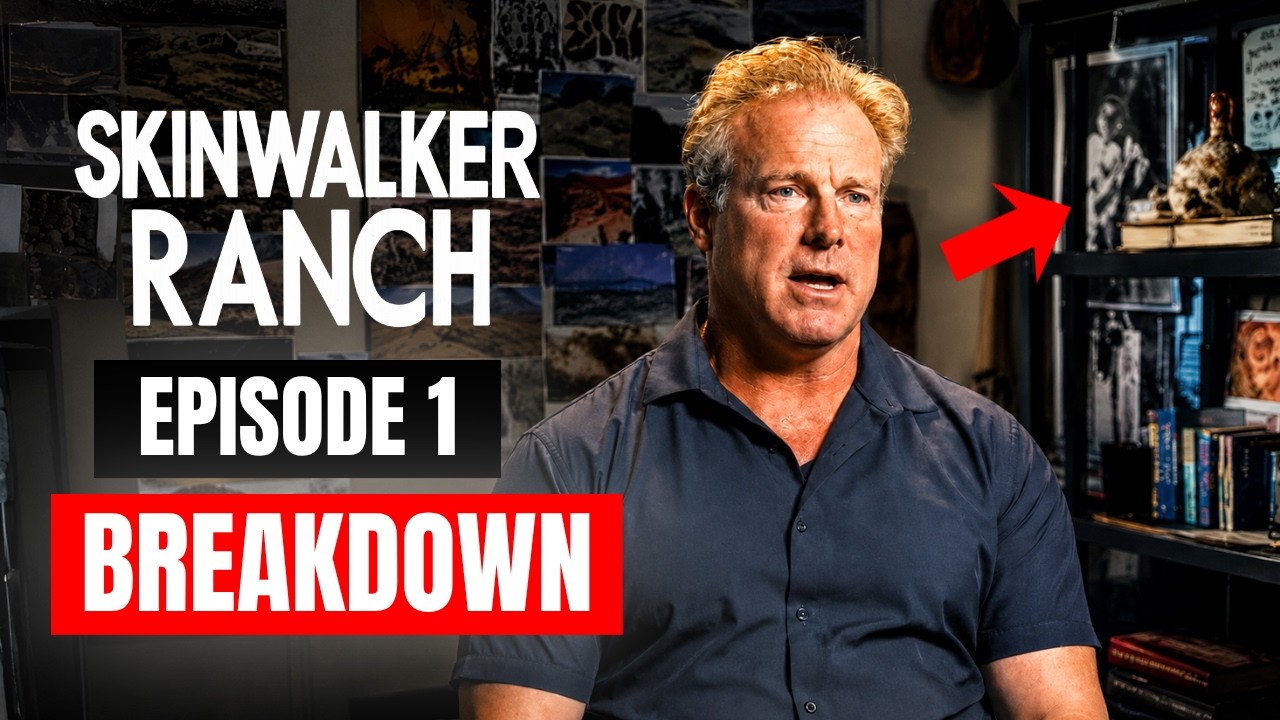
There are places on this earth that don’t follow the rules. Places where the instruments behave differently, where the sky above doesn’t match the sky anywhere else, where the ground beneath your feet holds materials that shouldn’t exist, and where every attempt to understand what’s happening seems to deepen the mystery rather than resolve it.
Skinwalker Ranch is one of those places.
For six seasons, a team of scientists, researchers, and investigators have been methodically probing one of the most anomalous pieces of land in North America. They’ve documented aerial phenomena. They’ve recorded electromagnetic disturbances that surge without origin.
They’ve pulled physical materials from the earth that have left laboratory analysts without clear answers.
And now, season 7 begins.
The title of this premiere episode is all fired up. That phrase carries two meanings, and both of them matter.
Fire, in the literal sense. The team deployed extreme heat above one of the ranch’s most active zones, deliberately and precisely as a controlled scientific stimulus. Fire, in the other sense.
Something responded.
This isn’t the beginning of a ghost story.
This is the beginning of a scientific escalation.
Because when you apply a known variable to an unknown system, and the system reacts, that reaction becomes data.
And the data coming out of Skinwalker Ranch in this season 7 premiere is unlike anything the team has recorded before. Something just changed on the ranch. The question isn’t whether you believe that.
The question is, what does the evidence actually show?
To understand what happened in this episode, you first have to understand what was found.
Over the course of prior seasons, the team at Skinwalker Ranch identified a formation on the property known as the Mesa, an elevated geological structure that has consistently produced anomalous readings and in more recent
investigations yielded physical materials extracted directly from its interior.
Among those materials, ceramic compounds.
That word, ceramic, might sound mundane, industrial even, but the significance here is not in the category.
It’s in the composition. Ceramic materials by definition require processing. They require extreme heat.
They require a transformation process that does not occur naturally within geological formations.
Rock does not become ceramic on its own.
Earth does not self-refine into processed compounds through pressure and time alone.
The presence of ceramic material inside a natural formation is, from a purely scientific standpoint, an anomaly that demands explanation.
And now, new tests have returned results.
The precise nature of those results, the specific elemental breakdown, the crystalline structure analysis, the temperature thresholds implied by the material’s formation, point towards something that standard geological models cannot comfortably account for.
The composition suggests exposure to temperatures and pressures inconsistent with the known history of the site.
The material shows characteristics of intentional formation rather than natural occurrence.
Something processed this material.
Something applied the conditions necessary to produce it. Whether that something was human, ancient, technological, or entirely outside current classification, that remains the central unanswered question. But the implication embedded in these new test results is significant enough that the team doesn’t treat it as background noise. They treat it as a signal.
And in this episode, they decided to respond to it.
Not all areas of Skinwalker Ranch behave the same way.
Over years of systematic investigation, the team has mapped zones of elevated activity, locations where anomalous readings cluster, where aerial phenomena recur, where equipment behaves erratically without conventional cause.
Some areas of the ranch are relatively quiet, others are not.
The triangle is not quiet. It is one of the most consistently active zones on the entire property.
Across multiple seasons, the triangle has produced recurring data signatures, electromagnetic fluctuations, thermal irregularities, and aerial phenomena that appear with disproportionate frequency relative to its geographic footprint. It is the kind of location that, in any serious scientific investigation, would be prioritized, studied, probed.
So, when the team decided to apply extreme heat as an experimental stimulus to see whether deliberate thermal deployment above the ranch would produce a measurable response, the triangle was not a random choice. It was the calculated one.
This distinction matters. There is a fundamental difference between passive investigation and active provocation.
For much of the show’s earlier seasons, the approach was largely observational.
Document what happens, measure what appears, record what the instruments detect. That methodology produced significant data, but this episode signals a shift.
The Skinwalker team is no longer simply watching. They are interacting.
They are introducing variables into a system that has demonstrated repeatedly that it notices. The decision to target the triangle specifically with heat, with intention, with instruments trained on every measurable frequency, is not incidental.
It is a deliberate act of scientific escalation.
What happens when you knock on the door?
The deployment itself is methodical, controlled, precisely the kind of measured, instrument supported operation that defines serious field investigation.
The team positions thermal equipment above the triangle. Environmental baselines are established. Ambient temperature, atmospheric pressure, electromagnetic readings across multiple frequencies, radar status. Every sensor on the property is active. Every monitoring station is staffed. The experiment is designed to be repeatable, documented, and analytically sound. The heat is applied.
In investigative fieldwork, there’s a particular kind of silence that precedes anomalous events. A moment where the instruments are running, the variables are in play, and the environment hasn’t yet responded.
That silence is not the absence of information.
It is the accumulation of it.
The thermal output reaches its target range. The triangle sits beneath the heat column.
The instruments continue their silent documentation.
And then, the baseline shifts. Not dramatically. Not in the way that would immediately register as cinematic. This is how real anomalies present. Not as explosions of data, but as deviations.
Small, then larger. Readings that move outside the expected range. Sensors registering fluctuations that weren’t present 10 minutes ago.
The kind of environmental inconsistency that, in isolation, might be dismissed.
But in context within this location, with this team’s years of comparative data behind them, cannot be.
The transition from controlled experiment to uncontrolled response is not a single moment. It is a gradient. A slow departure from expected parameters into something the team’s instruments capture, but their models cannot immediately explain.
The heat was the input.
What came next was not part of the experimental design.
What the team observed above the triangle following the thermal deployment is the central data point of this entire episode.
And it is the section of the investigation that resists the most straightforward explanation.
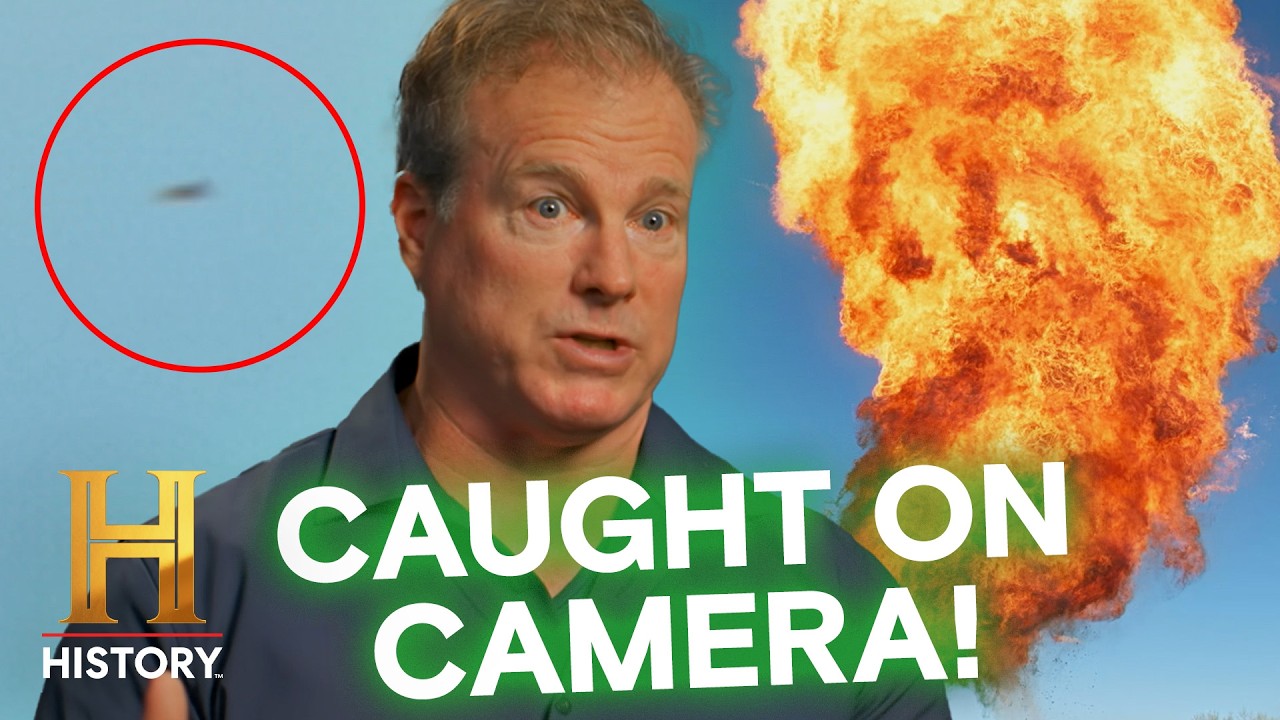
Phenomena appeared in the sky.
The nature of those phenomena, their visual characteristics, their behavior relative to wind patterns and atmospheric conditions, their presence on radar versus optical instrumentation, creates a data set that sits outside standard atmospheric classification.
These are not weather artifacts. They are not lens flares or camera malfunctions.
They are not drone activity or conventional aircraft. The team’s multi-instrument monitoring approach exists precisely to eliminate those explanations.
And in this instance, that elimination process does not resolve the observation into anything conventional.
What the instruments captured exists in the record.
Thermal imaging detects signatures that do not correspond to known heat-generating sources at altitude.
Radar registers returns that lack the consistent reflectivity profile of physical objects moving through standard atmospheric drag.
Visual documentation shows movement patterns inconsistent with wind-driven phenomena at the recorded atmospheric conditions.
Each of these data points isolated might generate a plausible alternative explanation.
Together as a simultaneous cluster of readings triggered in direct temporal proximity to the thermal deployment, they form something harder to dismiss.
The baseline deviation was not random.
It was responsive.
The sky above Skinwalker Ranch did not produce these readings before the heat was applied. It produced them after. That sequence, stimulus then response, is not proof of anything definitive, but in scientific methodology, it is exactly the kind of correlation that demands further investigation rather than comfortable dismissal.
Something was up there. Something that the team’s collective instrumentation detected across multiple independent systems simultaneously and it appeared only after they fired.
Here is where the investigation requires a broader lens.
The phenomena documented in this episode do not exist in isolation. They exist within a six-season archive of anomalous events at Skinwalker Ranch. A data set that when examined comparatively begins to reveal something more troubling than a collection of unexplained incidents. It reveals a pattern.
In prior seasons, aerial phenomena at the ranch have shown a recurring correlation with moments of elevated human activity on the property. Not passive observation, active investigation, equipment deployments, energy experiments, drilling operations, physical excavations.
Across multiple incidents, the ranch’s anomalous activity has demonstrated a tendency to intensify precisely when the investigative pressure intensifies.
That pattern creates a difficult question.
Is the ranch simply a location where strange things happen?
A passive anomalous zone that the team moves through and documents?
Or is it something more unsettling?
A system that reacts, a system that on some level that current science cannot fully characterize, registers external stimulus and generates a corresponding The data from this episode adds another data point to that second hypothesis.
The team did not observe aerial phenomena before the thermal deployment.
They observed them after.
The triangle, historically the ranch’s most active zone, produced a measurable response within the time frame of the experiment.
The ceramic materials from the mesa, whose anomalous composition already implies a history of high energy processing or the original catalyst for the entire experimental design.
Every element of this episode connects.
That connectivity is either coincidence or it is signal. And after six seasons of documented anomalies at this location, the team is increasingly operating under the working assumption that coincidence here is the less defensible conclusion.
Step back from the aerial phenomena for a moment.
Return to the ceramics.
The material extracted from the mesa underwent high temperature formation at some point in its history.
That is what the new test results confirm.
Something at some time applied the thermal conditions necessary to process that material into its current form. And now, the team has applied extreme heat above the same property in the zone most consistently associated with anomalous response, and the sky has produced phenomena that defy standard explanation.
Is that a coincidence or is it a feedback loop?
The hypothesis emerging from this episode is methodologically serious.
That the ceramic materials buried in the mesa and the aerial phenomena appearing above the triangle may not be separate mysteries.
They may be components of a single interconnected system. A system whose behavior is, in part, triggered by thermal input.
This would explain several things that prior seasons have left unresolved.
It would explain why the triangle produces disproportionate anomalous activity. It would explain why the mesa materials show evidence of high energy processing without a clear natural mechanism. And it would explain why, in this episode specifically, the application of heat produced a measurable sky level response.
If the materials were designed, engineered, deliberately placed to interact with specific energy inputs then the team at Skinwalker Ranch may have in this experiment accidentally activated something not a machine in any conventional sense but a system.
A responsive architecture embedded in the landscape itself operating on principles that current scientific frameworks have not yet developed the vocabulary to fully describe.
That is a significant claim.
The data as it stands does not prove it.
But it does not disprove it either.
Every serious investigation reaches a boundary.
Not a boundary of effort or commitment.
The team at Skinwalker Ranch has demonstrated both consistently over seven seasons but a boundary of available methodology. A point where the instruments have recorded everything they can record. The samples have been analyzed to the limits of current laboratory capability and the data sits on the table real documented peer reviewable but still without a clean explanatory framework to contain it.
This episode reaches that boundary. The aerial phenomena were recorded. The sensor data is in the archive.
The temporal correlation between the thermal deployment and the sky level response is documented and measurable.
The ceramic material’s anomalous composition is confirmed by independent laboratory analysis. None of this is in dispute.
What is in dispute? What remains genuinely scientifically open is what it means.
The ranch has a consistent and demonstrable history of resisting final conclusions.
Every time the investigation narrows toward a definitive answer the data introduces a new complexity. Every time a hypothesis gains traction a subsequent experiment produces results that complicate it.
This is not evidence of incompetence. It may in fact be evidence of something far more interesting. A phenomenon that is genuinely beyond the current boundary of human scientific understanding.
The questions that survived this episode’s data are not small ones.
What created the ceramic materials and when? What is the physical mechanism connecting thermal input at ground level to aerial phenomena above?
Why does the triangle consistently activate while other zones remain relatively dormant?
And perhaps most fundamentally, if this is a system, who built it? Those questions don’t have answers yet. That’s precisely what makes them important.
There is a moment in any long-running investigation when the methodology changes, when observation gives way to interaction, when documentation gives way to experimentation, when the investigators stop asking what is happening here and start asking, “What happens when we do this?” Skinwalker Ranch season 7 begins at that threshold.
The team that opens this season is not the same team, in approach, in confidence, in accumulated knowledge, that began season 1.
Six seasons of documented anomalies have produced something more valuable than any single data point, a deep comparative understanding of how this ranch behaves, what it responds to, what it ignores, where its activity concentrates and when.
That understanding is now being applied deliberately.
The thermal deployment above the triangle in this premiere episode is not an accident or an improvisation.
It is the product of years of pattern recognition applied with precision.
The team knows which zone to target.
They know what kind of stimulus the ranch’s history suggests might produce a response. They know how to instrument a field experiment to capture whatever emerges.
And what emerged in this first episode suggests the season ahead will not be quiet.
If season 6 was the season of extraction, pulling physical materials from the ground and subjecting them to laboratory analysis, then season 7 appears to be the season of activation, of deliberately engaging the system rather than merely observing it, of pushing variables into the unknown and measuring what comes back.
The ranch has always been the subject of the investigation.
It may be becoming a participant in it.
The experiment is over.
The equipment has been powered down. The instruments have been logged. The thermal deployment has ceased and the sky above the triangle has returned, at least visually, to its ambient state.
The team has filed their observations, secured their recordings, and begun the process of analysis.
But here is the question that lingers beyond the data.
What the team started on this day may not have ended when they stopped.
Skinwalker Ranch has a documented history of events that don’t respect the boundaries of scheduled investigations, phenomena that persist beyond the conclusion of experiments, anomalies that appear in the hours and days following active on-site operations, as though the ranch’s response curve extends beyond the immediate stimulus, as though whatever system underlies the activity here operates on a timeline that isn’t synchronized with human work schedules.
The ceramic materials are still in the mesa. The triangle is still there.
Whatever responded to the thermal deployment, whatever produced those sky-level signatures across multiple independent instrument systems, did not leave. It was already there before the team arrived this season. It will be there after the camera stop rolling.
Season 7 has begun with a deliberate act of provocation. The team fired heat into a zone that history suggests is already sensitive, already active, already demonstrating behaviors that science has not resolved.
And the zone responded.
What that response ultimately means, whether it is the end beginning of a breakthrough, the deepening of a mystery, or something else entirely that current frameworks aren’t equipped to name, remains to be seen.
But something was woken here.
Or perhaps more accurately, something was reminded that the investigation is still happening.
That it hasn’t stopped.
That the fire they started is still burning.