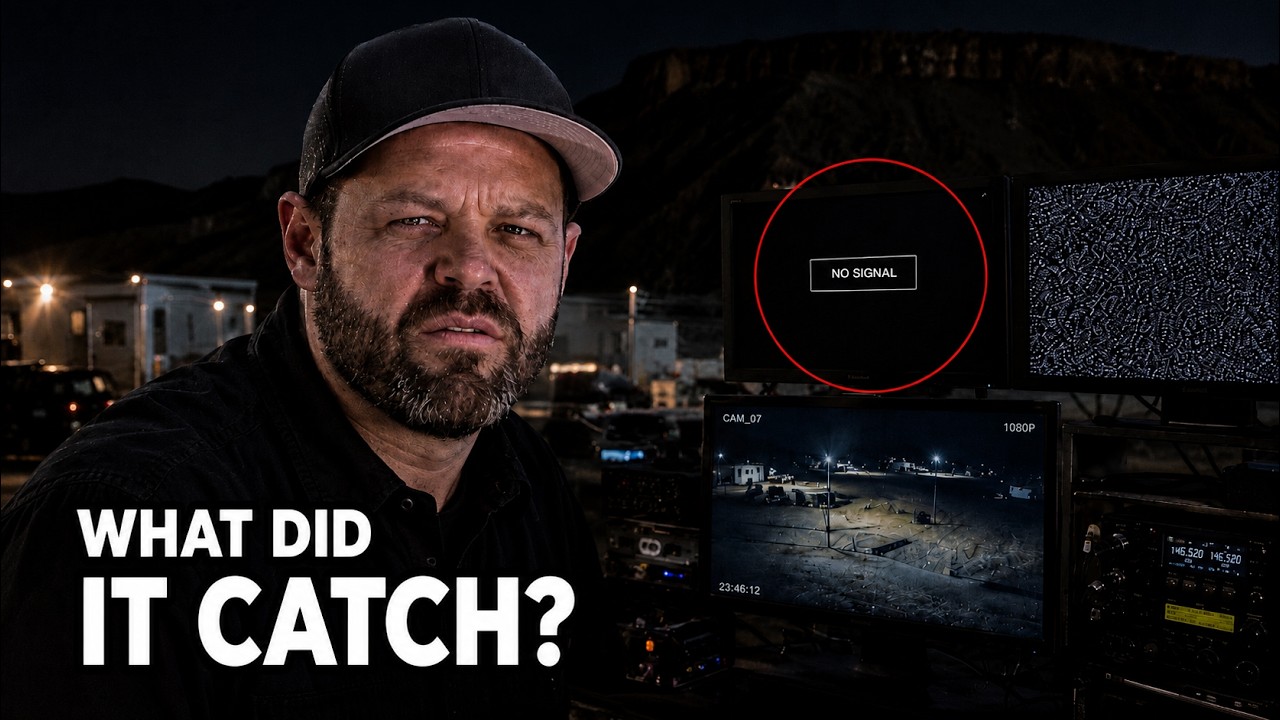
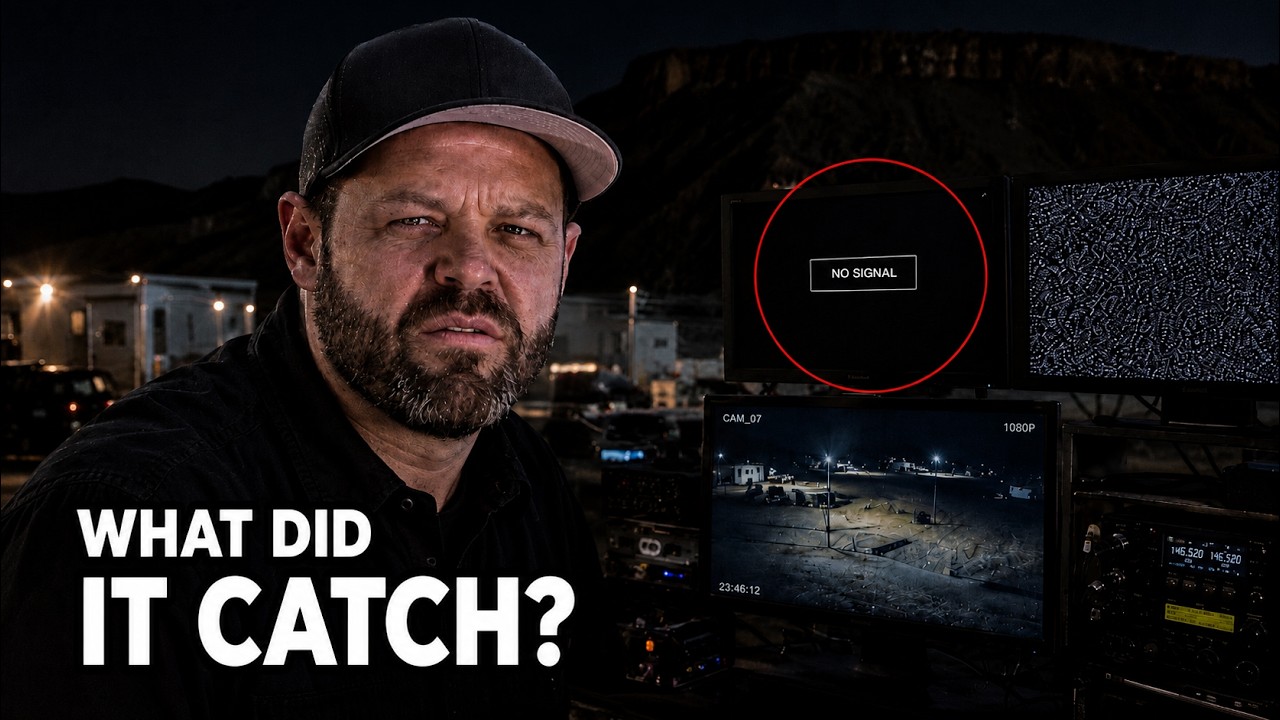
The monitor glows faintly in an empty room.
>> [snorts] >> On screen, the ranch just after midnight. The mesa sits dark and unmoving against a sky scattered with stars.
Everything reads as it should.
Temperature steady, motion sensors quiet, timestamp ticking forward in the corner second by second.
For nearly a full minute, nothing happens. This is what surveillance footage usually looks like. Empty.
Uneventful. The kind of recording that gets deleted and forgotten.
Then, just past the 12-minute mark, the image shifts. Not a cut. Not static.
A faint ripple moves across the frame like heat rising off summer asphalt.
Except it’s the middle of winter.
The timestamp keeps counting.
The audio keeps running.
But something in the picture is no longer quite right.
The screen did not go dark first.
Something changed before it disappeared.
And a camera going dark on a remote ranch is not by itself remarkable.
Cables corrode, power drops, signals weaken over long distances, especially in rough terrain.
In most cases, an investigator would log the failure, check the hardware, and move on. But this case did not move on.
What held the investigators’ attention was not the blackout.
It was everything stacked up against it.
The ripple, the timestamp, the sensor readings sitting quietly in a separate log file, untouched by whatever affected the picture.
Each piece alone meant a little.
Lined up in order, they meant something else. So, the team did what any careful investigation does. They went back to the start.
Not to ask why the screen went black, but to ask what happened in the seconds leading up to it.
And see, the timeline was lined up, the failure started to look less random.
Inside the command trailer, the atmosphere was routine.
A bank of monitors lined the far wall.
Each one tied to a different camera position across the property.
One covered the main gate. One watched the barn.
One held steady on the mesa. Its lens fixed on the same rock formation it had captured every night for months.
Two researchers sat at the console logging readings the way they always did.
Temperature, wind speed, radio frequency noise, motion sensor status.
A coffee pot sat half full.
A radio scanner murmured low in the background. Tuned to a frequency the team monitored out of habit more than expectation.
Nothing about the setup suggested anything unusual.
The ranch lights cast their normal glow along the fence line. The mesa sat still, exactly where it always sat.
Every feed displayed the same steady timestamp, the same quiet static image of a working night.
For nearly 2 hours, the logs would show nothing worth flagging.
Then, without warning, one feed began to drift out of sync with the others.
Not by much.
A fraction of a second at first. Easy to miss if you weren’t watching closely.
At first, it was just another quiet night on the ranch. Then one feed stopped behaving like the rest. The researcher nearest the console noticed it first. A small stutter in the Mesa feed, barely worth mentioning out loud.
The image held on a single frame half a second longer than it should have. Then it caught up as if nothing had happened.
He made a note.
Nothing more.
Feed stutter, bandwidth dips.
It happens on ranches like this one more often than people realize, especially with equipment running for hours at a stretch.
A few minutes later, it happened again.
This time the delay was longer.
The frame held, then a thin band of static crossed the screen top to bottom, gone almost as quickly as it arrived.
Still, on its own, this proved nothing.
A flicker is a flicker.
Cameras freeze. Signals fade in and out depending on weather, distance, and a dozen other unremarkable causes.
Anyone who has managed field equipment has seen a screen behave exactly like this and thought little of it.
What made the researchers pause wasn’t the glitch itself.
It was what the other monitors were doing at the very same moment.
The barn camera held steady.
The gate camera held steady.
Every timestamp across every screen kept counting forward, perfectly in sync, except for one.
At first, it looked like a normal glitch.
Then they checked the timing. Before anyone allowed themselves to think this was unusual, the team worked through the ordinary possibilities one at a time, the way any competent technician would.
They checked the camera housing for a loose connection.
Nothing out of place.
They checked the cable run along the fence line for wear or moisture damage.
Dry, intact, functioning within normal range.
They pulled the power logs to see if a voltage drop had tripped the system.
The numbers held steady.
No spikes, no dips.
They considered the weather.
It was a calm night.
No wind strong enough to shake the mounting bracket.
No storm activity anywhere in the region that could account for interference.
They checked the radio scanner logs for anything on the surrounding frequencies.
Aside from routine background noise, there was nothing unusual registered at the time.
One by one, the ordinary explanations were tested, and one by one, they came up short.
Not disproven, exactly.
Equipment failures can be difficult to pin down after the fact.
But nothing in the data pointed clearly at any single mundane cause.
What troubled the team more than the absence of an explanation was the shape of the failure itself.
A random equipment fault does not usually confine itself to one narrow window of time.
It does not usually leave every other system on the property running untouched.
A random failure should have behaved randomly.
This one appeared to line up with something else. Here is what the final seconds of the recording actually show.
The frame holds on the familiar view.
The ranch lights along the perimeter.
The mesa sitting dark against a field of stars.
Exactly as it had appeared for the past 2 hours.
Then, near the upper edge of the frame, the image begins to compress.
As though the picture itself is being pulled slightly out of shape.
It is subtle.
On a smaller screen, a viewer could easily miss it.
The static that had appeared briefly before now spreads further moving in from the edges toward the center.
A darker patch forms near the tree line though whether this represents an object, a shadow or simply a failure in the sensor is impossible to say from the footage alone. The image does not resolve into anything identifiable.
It does not hold still long enough to be examined closely.
The frame freezes for just under 2 seconds.
Then the signal collapses entirely and the screen goes black.
To be clear, the footage does not show a clean answer. It does not show a shape, a craft, or anything that can be identified with confidence. What it shows is a progression. Flicker, distortion, static, freeze, blackout.
Each step following the last right up until the moment the recording stopped.
The blackout was not just where the story ended.
It may have been part of the story itself.
If it had only happened on one screen, the answer would have been simple. But another system reacted almost at the same time. A visual glitch, however strange, is still just an image. Images can deceive. Sensors can misfire.
On its own, the camera footage would have remained an open question, filed away as unexplained and little more. But when the team pulled the radio scanner logs from that same window they found something that gave the footage new weight.
At almost the exact moment the camera feed began to distort, the background static on the scanner had briefly changed.
Not dramatically.
A slight rise in noise.
The kind that could be attributed to atmospheric conditions or a passing vehicle on the highway miles away.
Under ordinary circumstances, no one would have flagged it at all.
What made it different this time was the timing.
The increase in radio noise began within seconds of the first flicker on the Mesa camera.
It peaked close to the point where the image froze.
And it settled back to normal noise levels shortly after the screen went black.
None of this proved a connection.
Radio interference and camera glitches can each occur independently.
And coincidence in timing is not the same as cause.
The investigators were careful to say as much in their notes.
But it was enough to justify a closer look.
Two separate systems tracking two different kinds of data had each behaved unusually within the same narrow window of time.
Now the question was no longer just what the camera saw.
It was why two systems reacted so close together. When the team laid every log side by side, camera, radio, sensor, timestamp, a sequence began to take shape.
Not a single dramatic moment, but a chain of small ones, each following the last in an order too consistent to dismiss as coincidence. First, the Mesa feed shows a routine uneventful night, matching every other camera on the property.
Then comes the first flicker, small, [snorts] forgettable on its own.
Roughly 90 seconds later, the distortion returns, longer this time, followed by a rise in static.
Within that same window, the radio scanner registers its brief change in background noise.
Then the camera image compresses, freezes, and finally collapses into black.
And afterward, the surrounding systems behaved differently than they had before.
Some settling back to baseline almost immediately.
Others taking longer to stabilize.
Investigators who spend their careers on cases like this will tell you the same thing.
A single strange image rarely means much.
Photographs and video clips can be faked, misread, or explained away entirely.
What is far harder to dismiss is a sequence, a set of independent systems with no connection to one another registering change in the same narrow stretch of time in a consistent order.
It was not the flicker that convinced the team to keep digging.
It was not the static or the freeze or even the blackout itself.
It was the order in which they arrived one after another like dominoes.
The strongest detail was not what appeared on screen.
It was when it appeared. There is one detail in the report that made even the more skeptical members of the team stop and reconsider.
If every camera and sensor on the ranch had gone dark at the same moment, the explanation would have been simple.
A total power failure, a generator issue, a tripped breaker somewhere in the main line.
Investigators see this kind of full shutdown often enough to recognize it immediately.
If, instead, only the Mesa camera had failed while everything else showed nothing unusual, that too would have pointed to a simple answer.
A faulty unit overdue for replacement, nothing more.
But, what the logs actually showed was neither of those things.
The Mesa camera changed. The radio scanner changed in that same narrow window.
And yet, the barn camera, the gate camera, and the perimeter sensors continued operating exactly as they had all night without interruption.
This is the detail that mattered most.
Not a full blackout.
Not an isolated glitch.
A partial, localized event affecting two specific systems in the same location at nearly the same time.
While the rest of the site carried on as though nothing had happened.
For the team reviewing the footage, that distinction changed everything.
A full failure fits neatly into an equipment problem.
A single failure fits neatly into a bad camera.
But, a shared, localized, correlated event across two unrelated systems does not fit either explanation cleanly.
That is why the team did not treat it like an ordinary equipment problem. With the timeline established, investigators were left with three possible explanations.
None of them could be ruled out entirely. None of them fit perfectly, either.
The first and simplest was ordinary technical failure.
Cameras age, cables corrode, connections weaken over time, especially in remote exposed installations like this one.
This explanation required the least imagination and carried the most precedent.
Its problem was the second system.
A failing camera does not typically coincide with a change in a radio noise miles from the same equipment.
Technical failure explained the blackout. It struggled to explain the timing.
The second explanation was environmental interference.
Terrain, weather, or localized electrical disturbance affecting nearby equipment.
Ranches like this one sit in remote, often rugged terrain, and unusual atmospheric conditions can and do interfere with electronics.
Its problem was specificity.
Environmental interference tends to be broad and inconsistent, not narrowly confined to one camera and one radio window in that order, on an otherwise calm night.
The third explanation was the most difficult to state plainly, let alone prove.
Some localized effect tied specifically to that stretch of the ranch, briefly interfering with more than one system at once.
This explanation fit the timing more closely than the other two.
It also carried the least evidence and the greatest risk of overreach.
Each explanation answered part of the event.
None of them explained the whole sequence cleanly. For anyone who has followed reports out of Skinwalker Ranch over the years, none of this arrives entirely out of nowhere.
Equipment trouble has a long history here.
Cameras that lose signal without explanation, GPS units that briefly lose their lock, radio interference that comes and goes without a clear source, sensors that log readings no one can fully account for.
Researchers on site have grown accustomed to a certain baseline of unreliability.
One they factor into every investigation before it even begins.
What sets this event apart is not that a camera failed or that a radio signal briefly changed. Those things individually fit the ranch’s established pattern.
What stands out is the combination of visual distortion, a near simultaneous shift in a separate system, and a sequence of events tight enough in timing to raise real questions rather than simply being logged and forgotten.
It is the difference between an isolated incident and a repeated signature.
One strange night can be dismissed.
A pattern building over years is harder to wave away.
That pattern is what made this blackout more serious than a simple lost feed.
There is an irony at the center of this case that is worth sitting with.
Ordinarily, a camera failure destroys evidence.
The recording stops, the picture goes dark, and whatever might have happened next is simply lost, unrecoverable, gone.
Here, the failure itself became something closer to the opposite.
Because of what preceded it, the flicker, the static, the radio disturbance, the precise order in which each piece arrived, the blackout stopped being an ending and started being a data point in its own right.
The question investigators were left with was not whether the camera failed.
It clearly did.
The question was, what caused it to fail in that particular way? At that particular moment.
Alongside a second system reacting almost in step.
Was this the ordinary behavior of aging equipment under difficult conditions arriving by coincidence at an unfortunate moment?
Or was something in the environment briefly affecting more than one system at once in a way current instruments were never designed to fully capture?
And that leaves one uncomfortable question. Return for a moment to where this began.
A quiet monitor. An empty room. A ranch settling into another routine night.
Until it wasn’t.
The flicker.
The static creeping in from the edges.
The frame holding a half second too long.
The second system reacting in that same narrow window miles away and yet somehow in step.
And then finally, the black screen.
The same one this story opened with.
Though it no longer looks quite as simple as it did at the start.
No one on the investigation team claims to know exactly what happened that night.
The footage does not offer a clean answer. And the honest ones among them will say so plainly.
Was this just a technical failure?
Or was the failure itself part of the event?
That’s worth sitting with. Because in a case like this, the timing may matter more than the footage itself.
Did the camera fail before it captured something important?
Or because it captured something important?