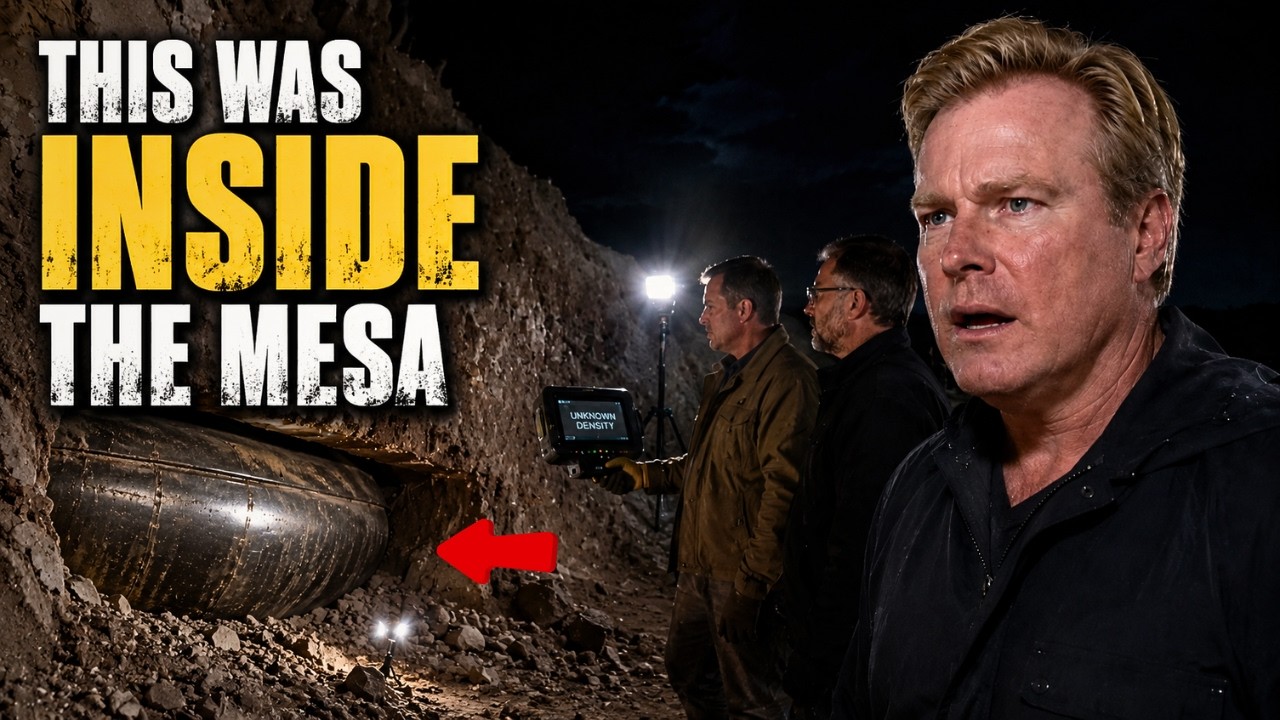
500 feet beneath a windscoured messa in northeastern Utah, a diamond tipped drill bit shutters to a stop. It is the second bit destroyed in as many days.
When the crew pulls the drill string and empties the spoils onto a steel tray, something in the debris doesn’t belong.
a dense layered fragment, gray and faintly metallic, unlike anything the surrounding sandstone has produced in five seasons of digging. A technician runs a handheld gamma counter over the piece. The needle jumps 108 counts per minute, then 110, then 115.
Nearly 10 times the background reading expected from ordinary rock at this depth.
For a moment, no one in the command center speaks.
Then the lead physicist checks the number against an old data log, and the room goes quiet for a different reason.
It’s the same reading almost to the count as a ceramic-like sample the team pulled from this same mea months earlier. A sample that has never been fully identified.
Two unrelated pieces of material recovered from two different depths months apart are giving off the exact same signature.
The scientists have a working theory about what lies beneath this ground, but this fragment does not fit any version of it they had planned for. And the drill still has hundreds of feet left to go. The decision to drill this exact coordinate wasn’t made overnight. For years, ground penetrating radar and other subsurface imaging equipment had been run across nearly every accessible section of this 500 acre property. Most scans returned exactly what geologists would expect. Undisturbed layers of sediment consistent with the region’s known formation.
One location did not. Scan after scan across multiple seasons and multiple instruments, the same anomaly kept reappearing beneath the mesa. A large, dense structure buried far deeper than natural cave systems typically form in
this type of sandstone.
Independent operators working with different equipment on different visits kept returning the same result. It was that repetition, not a single reading, but years of overlapping data that ultimately justified committing a multi-season drilling program to one specific point on the map. The working assumption was straightforward. If the anomaly was real, a drill would either confirm it in a matter of days or eliminate it entirely.
Neither happened. Instead, as the drill approached the depth where the radar had flagged the object, it began behaving in a way no one on site could explain, as if it were no longer cutting through rock at all. Deep inside the Mesa, the drill stopped cutting. It wasn’t a mechanical failure, it was resistance.
The crew had switched to brand new tungsten carbide bits for this stage of the excavation. hardware engineered specifically to cut through solid rock.
Within minutes of contact, the bit came back worn smooth, its cutting edges rounded off as though ground down by something harder than the bit itself. A second bit went in, then a third. Each one failed the same way with no fractures or hard bands in the surrounding formation that could account for the wear. Geologists offered an early theory, a dense basaltt intrusion, hard volcanic rock, not uncommon in the region. It was a reasonable explanation until the readings came in. Operators monitoring the drill string reported the obstruction actively pushing the rod downward under pressure, then moments later forcing it back upward. Basalt doesn’t do that. A stationary formation resists a drill. It doesn’t redirect one. It wasn’t the program’s first unexplained result, either. Earlier in the same operation, material pulled from the spoils pit had included a strange greenish pink gel-like substance laced with burnt plant matter and charcoal.
Organic content with no match anywhere in the site’s known geological record.
For a team that had spent years chasing a radar signal no one could fully explain, a ruined drill bit was different. It was physical. It was measurable. It was something a skeptic couldn’t dismiss. What kind of material can stop industrial cutting equipment, redirect a steel rod under pressure, and still arrive packaged with organic matter that shouldn’t exist at that depth? The team sent the recovered samples to an outside laboratory for independent testing. When the results came back, they didn’t settle the question. They split the room in two.
The video call connects at 9:14 a.m. On the other end, an independent materials lab has the ceramic and metal fragments recovered from the site laid out under diffused light, already scanned, already sectioned.
The report comes in flat procedural language, the kind that carries more weight because it isn’t trying to. The fragments show a layered internal structure.
not random fracturing layers stacked with a consistency that reads as engineered.
The elemental composition, the lab notes, overlaps with alloys and coatings documented in aerospace shielding, the kind built to survive re-entry heat, not to sit in soil. Then the second finding lands. Several of the fragments register as radioactive, low-level, but measurable, repeatable, confirmed on a second instrument before anyone on the call is willing to say it out loud. For a moment, no one on the feed speaks. These are not amateurs reacting to a strange rock. These are engineers and physicists who’ve spent careers being the person in the room who explains things away.
And even they don’t have a shared answer because the counterpoint is sitting right next to the result and it hasn’t been ruled out.
Geologists on record point to something almost as strange in its own right. that sandstone under the right mineral and pressure conditions can grow dense layered concretions that mimic engineered structure without a single human hand involved. Nature building something that looks manufactured by accident. So the room splits. If it’s natural, why does the layering read like shielding built to a purpose? If it’s built, why was it recovered from solid rock at that depth with no excavation, no disturbance, no record of anyone ever putting it there?
While the lab argued over what the material was, the instruments running elsewhere on the site picked up something the material itself couldn’t explain. The camera goes down at roughly 240 ft, built for exactly this kind of work. a sealed housing, its own lighting array, cable feeding realtime footage back to a monitor on the surface. The screen shows black. Not dim, not grainy, black. Despite light strong enough to illuminate a room, and inside that black, at irregular intervals, brief specks of light flare and vanish. No pattern the operators can predict, no reflection they can explain.
The team’s physicist offers the only working theory. Gamma radiation striking the camera’s sensor directly, registering as light where there is none. It’s a plausible mechanism. It is not a confirmed one. The instruments on the surface tell a separate stranger story. During active drilling, a spectrum analyzer parked near the rig starts logging signals. It has no reason to log. Sharp readings at 1.2 GHz and 1.6 ghahertz. One of those frequencies matches almost exactly the beacon used to track the drill head underground.
The problem is procedural and it’s not small. That beacon is confirmed powered off at the time the signal appears. No one on site claims to know what produced it. This isn’t a witness account or a feeling picked up on camera. This is equipment engineered to be dull and dependable logging numbers it shouldn’t be able to log on a frequency it shouldn’t be able to receive. If the beacon was off, something else put a signal on its exact channel. And whatever kept that borehole camera in total darkness did it against lighting designed to make that impossible.
As if the mesa wasn’t strange enough on its own terms, the drill spoils delivered one more find, and it pointed toward a mystery older than the investigation itself. At roughly 496 feet, sifted out from the drill spoils, the team finds a 1964 US nickel. It’s small, ordinary, the kind of object that would mean nothing anywhere else. Here it means the ground at that depth was disturbed sometime after 1964 by someone using some method decades before this investigation ever broke ground. That single date sends the team back into the archives. A 1969 aerial photograph covering the site draws immediate scrutiny. On review, the image appears to have been altered, though the team stops short of claiming to know by whom or why. What they can say for certain is narrower and in its own way more unsettling.
Aerial and satellite imagery of this specific location from 1964 through 1968 cannot be located anywhere. Not misfiled, not low resolution, absent.
Four years of the visual record gone, bracketing the exact window that nickel points to below ground. The drilling operation hasn’t moved. The same unidentified hard material that stopped progress before is still there, still refusing to let any camera or sensor confirm what sits at the bottom of that bore hole. Which means the story may never have been about something arriving from outside at all. It may be about something buried by human hands on this messa more than half a century ago and a paper trail that stops cleanly at exactly the moment it would have mattered most. Who was working this ground in the 1960s?
And why does the record go quiet the instant they started?
With the drill stalled and 6 years of the historical record missing, here’s where the investigation actually stands.
Lay it out in order, and the pattern is hard to ignore. It began with a radar anomaly that sat unexplained for years before anyone drilled a single hole.
Then came the drilling itself. A campaign that destroyed bit after bit against a material no one could identify.
A recovered fragment tested as layered, engineered, and radioactive. While geologists on the same call couldn’t fully rule out a natural explanation.
A borehole camera lit and functional returned nothing but black, interrupted by flashes. The team’s own physicist attributed to gamma radiation.
A spectrum analyzer logged a signal on the exact frequency of a beacon confirmed to be powered off. And at 496 ft, a 1964 nickel surfaced from ground that archival photography says was never touched. Because 4 years of aerial imagery over that precise location simply isn’t in any archive anyone has checked. Taken individually, each finding has a possible explanation.
Taken together, they haven’t been reconciled into one. As of the most recent work on site, the team is still attempting to core deeper between the original bore holes. No material has been identified with certainty. No signal has been traced to its source. No explanation has been confirmed for the camera, the coin, or the missing years of film. And that for investigators who deal in evidence rather than certainty, is the honest place to leave it. of everything pulled out of that messa, the ceramic, the radiation, the signals, the detail that should bother you most is the smallest one. Six years of aerial photography over this exact spot simply don’t exist anymore. Someone made sure of that. To this day, nobody has explained who or