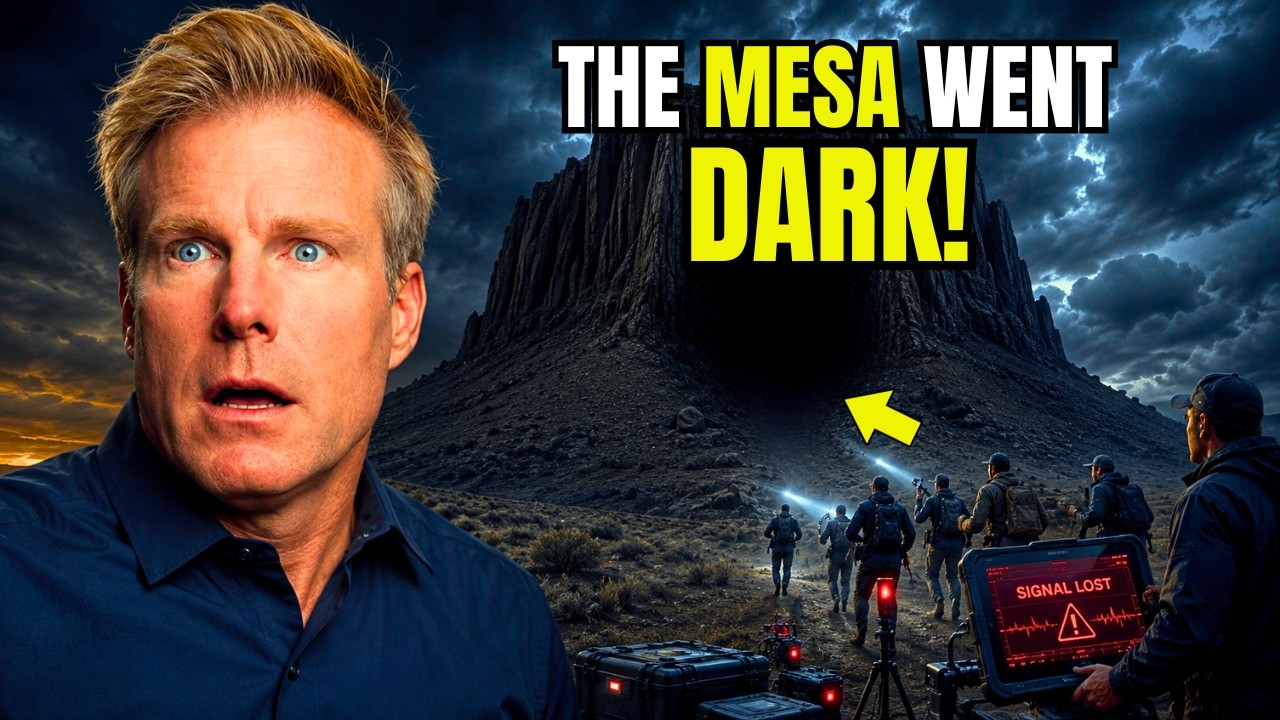
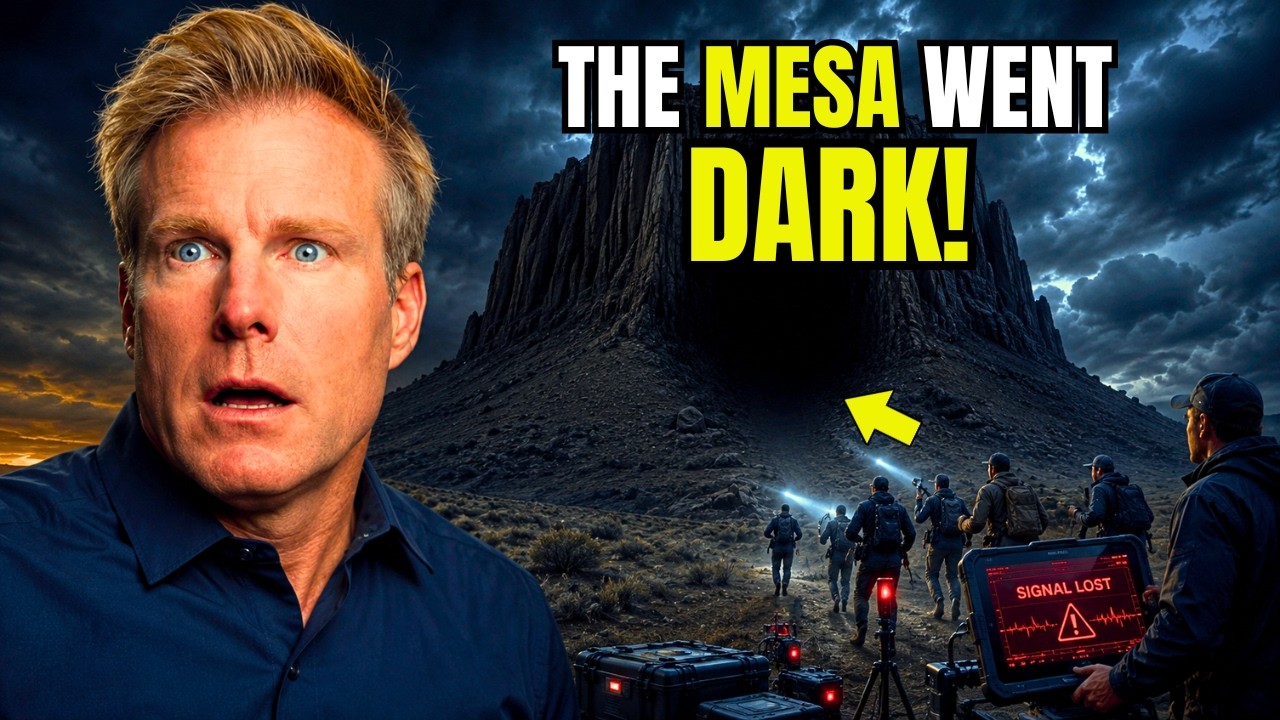
Out on Skinwalker Ranch, familiarity can be a fragile thing. A person may stand in the same patch of ground, look toward the same ridge, the same rise of stone, the same hard line of mea against the Utah sky, and still feel on certain evenings that the land has changed its mind. That is what made this moment so unsettling.
Nothing dramatic announced itself at first. No siren, no flash, no sudden shout from the field, only a subtle disturbance in a place the team knew well. And then the quiet realization that the mesa no longer looked the way it should. At this ranch, the mesa is never just part of the background. It sits over every operation like a witness and perhaps like a participant. Its broken face of rock, its cavities, its ledges, its long shadow at the edge of daylight have become inseparable from the ranch’s most persistent questions.
Investigators have watched it during launches, monitored it during surveillance, and returned to it whenever instruments behaved strangely, or sightings clustered in ways that refused to feel random. So when its outline appeared to darken in a way that did not fit the hour, the weather, or the eyes expectation, the reaction was immediate, though measured. People who had spent enough time out here to know the difference between an unusual image and a meaningful one, became still for half a second, then alert. The first impression was not that the mesa had disappeared, but that it had lost its shape. Features that should have remained visible seemed to collapse into a flat darkness. Texture was gone.
Contrast was off. The stone looked less like stone than like a section of space where the normal rules of light had briefly withdrawn. That alone would have been enough to draw attention. But what
gave the moment its force was timing.
The sky beyond did not appear to support what the eye was seeing. The surrounding terrain did not immediately echo it. The darkness seemed too narrow, too specific, too intentional in its placement to be easily absorbed into the ordinary language of shifting light. One person looked again to be sure. Another checked a monitor. Someone else stepped outside for a direct visual confirmation, as if distance from the screen might restore common sense.
Instead, the uncertainty deepened. Was the effect on the land itself? Was it something seen only through a certain camera path? Had cloud cover moved in some peculiar band? Had power dipped somewhere in the observation chain?
Questions arrived before anyone was ready to answer them? And that is often the true beginning of a skinwalker ranch event. Not the anomaly itself, but the instant disciplined people realize they cannot place it where it belongs.
What turned concern into urgency was not fear, at least not at first. It was recognition. The team knew this location too well to dismiss what they were seeing as a casual visual trick. The mesa had already earned a kind of uneasy importance in the life of the ranch. Too many strange readings had gathered near it. Too many unexplained aerial observations had appeared above or alongside it. Too many moments of interference. Too many abrupt disruptions of signal. Too many witness accounts colored by the same blend of certainty and incompletion had pointed back toward that mass of stone. The mesa had become more than a landmark. It had become one of the ranch’s recurring centers of gravity, a place where events seemed to concentrate before dissolving into uncertainty.
That history mattered. Now, if this had happened over some distant fence line or along an ordinary slope, the team might have noted it and moved on. But over the mea, even a small deviation carried weight. Memory changes the speed of human response. Once a place has repeatedly challenged explanation, the next irregularity does not arrive alone.
It arrives carrying everything that came before it. Old equipment failures, unsettling timing, glimpses of motion in the wrong place, strange correlations between observation and malfunction. The team did not have to say all of that out loud. It existed in their posture, in the quickness of their checks, in the way a few clipped words over the radio held more concern than a raised voice would have. Skinwalker Ranch has always posed a difficult challenge for serious investigators.
A place with a reputation can tempt a person to interpret too quickly. Yet, the opposite danger is equally real. to become so cautious about appearance that one ignores a genuine pattern unfolding in real time. The team working here lives inside that tension. They know the stories. More importantly, they know the operational record. They know how fast a strange event can emerge, distort several streams of observation at once, and then vanish before it can be fully documented. That is why the scramble began when it did. Experience had taught them that hesitation can cost evidence.
Radios came alive first. Simple confirmations were requested. Are you seeing that from your angle? Check the feed again. Is that the same on the outside camera? Someone moved toward a better line of sight. Another stayed with the monitors looking for any shift in exposure, any flicker, any indication that the darkness belonged to the equipment rather than the landscape.
Professionalism was still intact, but so was confusion. The group was trying to establish one basic fact and finding that even this was slippery. What exactly had gone dark? From one position, it seemed like a localized shadow. From another, it looked more like a loss of definition across a particular section of rock. On a screen, the image appeared compressed into an almost featureless patch. To the naked eye, it felt wrong in a harder to define way, as though the proportions of light and distance had stopped agreeing with one another. This disagreement in first impressions is one of the most revealing features of such moments. If everyone instantly sees the same thing in the same way, explanation often comes soon after. But when observers in the same investigation begin using different language for what they are witnessing, the event often proves more complex than it first appeared. The pace quickened.
Movement across the property increased.
Eyes shifted between land, sky, and displays. The possibility of an ordinary explanation remained very much alive, but it was already being tested by the shape of the event itself. A cloud can cast a shadow. A camera can misread contrast. A monitor can momentarily fail. Yet the team had spent enough time around this terrain to sense when a simple explanation was not fully carrying its share of the load. What bothered them was not merely that the mesa looked darker. It was that the darkness seemed to break the logic of the scene. Any responsible investigation has to begin with the practical. That is what happened here. Weather was considered first because weather is often the quiet architect of confusion.
Was a cloud bank passing in front of the sun at just the right angle? Was haze altering depth perception? Had changing light along the horizon created a brief flattening effect? Those possibilities could not be ignored. But a practical explanation becomes persuasive only when it fits the whole environment, not just one fragment of it. If the mesa alone seemed affected while adjacent terrain held its expected tone and clarity, then weather began to look less complete as an answer. Camera behavior was next.
Exposure settings can create illusions, especially in difficult light. A sensor can protect bright sky and sacrifice detail in darker foreground. Compression can smear texture. Gain can fluctuate.
The team understood all of this. They had learned not to mistake technical artifacts for mysteries. So they checked whether the image pipeline itself might be the source. Was one camera darkening while another remained normal? Did the same effect appear across separate feeds? Was the display losing information or was the phenomenon persisting outside the monitors as well?
Every answer mattered, not because it proved anything extraordinary, but because each one removed a layer of fog.
Power interruption had to be considered, too. If some portion of the surveillance or support equipment had dipped, that could distort the appearance of the mesa or make the darkness seem more abrupt than it was. But again, the problem was specificity.
A simple power issue should leave fingerprints in other places. A broader disturbance should touch multiple systems in recognizable ways. A clean explanation should widen, not narrow, under scrutiny. Here, the opposite seemed to be happening. The more the team checked, the more the event held its strange shape. The ranch itself encourages this kind of care. Distances can be deceptive here. A shallow angle of light can transform stone into silhouette, and a slight atmospheric shift can make a ridge look closer, flatter, or strangely cut off from the land around it. The team knew that many of them had spent enough hours watching the mesa under changing conditions to understand its ordinary moods. Dawn gave it one character. Midday gave it another. Late afternoon could make its shelves and openings look sharper than they were. Evening could soften its face until the surface seemed almost painted.
But what confronted them now did not feel like one more variation inside a familiar range. It felt like a subtraction, as if information had been removed from the scene instead of merely dimmed.
That distinction may sound subtle, but for investigators, it matters. Light changes gradually unless something interrupts it. Shadows behave according to geometry unless something distorts perception. In daily life, most people do not stop to parse those differences.
On a ranch where unanswered events are studied in detail, those differences become everything. The team was not just asking whether the mesa looked darker.
They were asking whether the darkness behaved like light at all. And timing continued to trouble them. The onset felt sudden. The affected area felt selective. The duration was long enough to provoke response, but uncertain enough to keep the team from settling into any one conclusion. If this was only light, why did it feel so geographically precise? If it was only a camera anomaly, why were in-person observations not instantly dismissing it? And if it was neither, then what had changed? That question began to move quietly through the investigation, changing its center of gravity from what the team saw to what the ranch might have been doing. At Skinw Walker Ranch, a visual event becomes more serious the moment instruments begin whispering along with it. Human perception can mislead. Even experienced observers can be fooled by angle, fatigue, expectation, or atmospheric conditions.
Machines are not immune to error either, but they fail differently. When equipment behavior begins to overlap with eyewitness uncertainty, investigators pay closer attention. That overlap does not guarantee a discovery.
What it offers is something more valuable in the early stages. a reason to treat the event as potentially multi-layered.
The team began checking the usual companions to unexplained disturbances, communications, signal stability, power behavior, battery performance, sensor continuity, surveillance reliability. Was anything else acting strangely during the same window in which the mesa appeared to darken? reports started to form.
Tentative at first, a minor glitch here, a brief inconsistency there. Nothing overwhelming on its own. Nothing clean enough to wave in front of a conclusion, yet enough to raise the pressure inside the room. The ranch has a way of producing incidents that seem trivial when separated and more disturbing when aligned. A radio hesitation might mean nothing. A device lag might be ordinary.
A sensor gap could be routine noise. But if several small irregularities touch the same slice of time, the emotional atmosphere changes. Suddenly, the event is no longer just an image that looked wrong. It becomes a cluster, a pattern in progress. The kind investigators learned to watch with care because the individual pieces often refused to explain the whole. That was the emerging mood around the blackout. Nobody could yet say that the darkness caused interference or that interference caused the darkness or that both were effects of some deeper mechanism. But the possibility that they were connected was becoming harder to dismiss. This is where the human element becomes impossible to ignore. Long before a report is written or a timeline reconstructed, an investigation lives in bodies and voices. You can hear it when speech becomes more economical.
You can see it in the way people stop filling silence with casual talk. The team at the ranch was not made uneasy by the mere idea of mystery. They work in mystery all the time. What unsettles experienced investigators is the moment a scene begins to pull against their internal map of what is normal. That happened here. A person can be skeptical and unsettled at the same time. In fact, that combination is often more revealing than belief. The team’s reactions suggested not excitement but concentration under strain. Heads tilted, eyes narrowed, responses shortened. No one wanted to overstate the event, and yet no one was comfortable dismissing it. That balance, the refusal to exaggerate, paired with the inability to relax, is one of the clearest signs that something about the moment felt operationally real. For those who have spent years in difficult investigations, the emotional burden does not come from one frightening image. It comes from accumulation, from the knowledge that certain places develop histories of resistance. A reading fails here. A launch behaves oddly there. A witness describes something that seemed impossible until a later event rhymes with it in unexpected ways. Over time, investigators do not necessarily become more credulous.
Often, they become more careful, more disciplined, and in a quiet sense, more haunted by incomplete patterns. The darkness over the mesa may have triggered exactly that feeling. Not panic, but the return of unfinished questions. Older viewers, perhaps more than anyone, understand the weight of that kind of reaction.
Serious people do not need to shout to communicate concern. A lowered voice can say enough. A pause can contain a full argument with one’s own senses. Out on the ranch, that was part of the reality of the moment. The event was not being processed as entertainment. It was being carried by men and women trying to remain precise while standing inside ambiguity. emotional reaction was not evidence. Nobody treated it as evidence, but it was still part of the truth of the night. Experienced observers had been moved out of their ordinary composure, and that fact deserved attention. Even the silence between responses began to carry information. In ordinary operations, quiet can be restful. During an anomaly, quiet becomes diagnostic. People pause not because they have lost interest, but because they are choosing language carefully, testing whether what they are about to say matches what they truly observed. That care was part of the atmosphere. Now, nobody wanted to contaminate the event by speaking too boldly. Nobody wanted to make the ranch stranger than it already was. And yet, the restraint itself suggested gravity.
If the moment had felt trivial, speech would have loosened. Instead, it narrowed.
One of the enduring difficulties of places like Skinwalker Ranch is that the line between environment and experience can become uncomfortably thin. A person is not only measuring the land. The land in a sense is measuring the person, testing patience, perception, and the ability to remain steady when familiar categories begin to blur. That is one reason such events linger. They do not simply present a puzzle. They implicate the observer in the puzzle. The team’s unsettled reaction was therefore not a distraction from the evidence. It was part of the context in which the evidence had to be understood.
Once the immediate scramble eased, the investigation entered its most revealing phase, reconstruction.
This is where many mysteries either thin out into the ordinary or deepen into something more difficult. The team began working back through the event from first notice to final dissipation. Who saw it first? At what exact point did the mesa begin to lose detail? Which camera feeds were active? Which radio calls can be matched to visible changes?
How long did the effect persist? Did it shift, broaden, retract, or simply vanish? Timelines have a way of disciplining imagination. They force events to sit still long enough to be compared. As those comparisons began, certain points seemed stable. The visual anomaly had been noticed quickly. It had triggered a response faster than a mere aesthetic curiosity would have. More than one observer had regarded it as abnormal. Yet uncertainty remained at nearly every edge. Different vantage points produced different descriptions.
Recorded media did not resolve every disagreement.
Some timestamps aligned cleanly, others seemed frustratingly incomplete. The ranch was offering a moment of disturbance, but not a clean document of that disturbance.
Camera angles were compared for consistency. If the darkness behaved like an ordinary shadow, it should track in ways that geometry would support. If it behaved like a lens problem, it might remain fixed to a device or reveal itself through image artifacts. If it marked a localized atmospheric condition, it should show some relationship to surrounding features, but the event resisted easy classification.
In one frame, it seemed bounded. In another, it felt more diffuse. In some observations, it resembled a flattening of the mesa’s surface. In others, it looked like an actual withdrawal of illumination. None of these descriptions fully defeated the others. Instead, they formed an uncomfortable overlap. Then came the blind spots, which are often the most eloquent part of a ranch investigation.
missing seconds, partial records, inconclusive instrument behavior, data that is not absent enough to be ignored, yet not complete enough to settle anything. This is where frustration enters because investigators are left studying the outline of an event as much as the event itself. It becomes possible to wonder whether what they captured was only the visible trace of a larger process operating just beyond their best tools. That idea can sound dramatic when stated carelessly. In careful hands, it remains a hypothesis of scale. Perhaps the blackout was not the full phenomenon, only its surface expression.
Perhaps the darkness over the mea was one symptom among several connected to a temporary environmental disruption, a technical convergence, or something more exotic that the team is not prepared to name. The closer the reconstruction came to the event, the less the moment seemed random, not because it declared its meaning, but because it appeared selective. It had happened in a place already charged with prior anomalies. It had taken a form too narrow to feel generic. It had provoked both visual uncertainty and at least some suggestion of instrument instability. That combination gave the incident a durability beyond its duration. In the end, the strongest facts remained modest but stubborn. The mesa appeared to darken in a way the team did not expect.
The effect was striking enough to trigger an immediate operational response. Simple explanations were considered seriously and did not comfortably settle every part of the event. Observers reacted with unusual concern. Equipment checks suggested the possibility, though not the certainty, of overlapping irregularities.
Reconstruction clarified some details while preserving deeper uncertainty. On paper, that may sound restrained. At the ranch, restraint is exactly what gives such moments their power. A different kind of investigation might be tempted to force an answer here, to call it proof of one thing or another, to collapse ambiguity into certainty for the sake of dramatic relief. But that would miss what makes the event meaningful. The value of this moment may not lie in demonstrating something extraordinary beyond all doubt. It may lie in exposing the limits of what the team can currently observe with confidence. For a brief span of time, the ranch disrupted visibility, interpretation, and measurement at once.
It took a familiar landmark and made it unfamiliar, not by removing it, but by altering the relationship between seeing and knowing. That may be why the mesa continues to occupy such a powerful place in the ranch’s story. It stands as a boundary not simply between earth and sky or daylight and shadow but between what can be monitored and what still evades definition. Every