What unsettles a serious investigator is not always the sight of something impossible. Sometimes it is something quieter than that. A measurement that repeats when it should not repeat. A shape that appears where randomness should have been enough. A buried response from stone that begins to look less like accident and more like arrangement. And on Skinw Walker Ranch, where strange claims have drifted through rumor and television alike for years, one of the most unsettling developments may not be a light in the sky or a signal in the dark. But the growing suspicion that deep inside the mesa, something is organized, that is what gives this mystery its unusual weight. A single object underground can be explained away in a dozen ordinary ways. Old debris, broken machinery, natural mineral concentration, a void in the wrong place. But a pattern is harder to dismiss. A pattern suggests repetition. Repetition suggests process.
And process sooner or later forces one difficult question into the open. If something beneath the mesa is structured, then who structured it? What shaped it? And why has it remained hidden beneath that wall of rock for so long? The reason that question now feels more serious than sensational has much to do with the people asking it. Travis Taylor is not presented as a man startled by every strange sound on the wind. Over the course of the ranch investigation, he has been surrounded by ambiguous readings, strange reports, failed experiments, and images that could easily tempt a less disciplined mind into theatrical conclusions. Yet, what has made certain moments stand out is not excitement alone, but restraint giving way to concern. When calm investigators begin to linger over data.
When technicians go quiet instead of celebrating. When an explanation is not rejected but simply starts to weaken
under repetition. That is often when a mystery becomes more interesting than the stories built around it. And the mesa has been building toward that kind of moment for years. Long before anyone began speaking about hidden patterns.
The mesa had already earned a reputation as one of the ranch’s most stubborn and puzzling features. It sits there like a natural boundary and an unanswered thought. A mass of stone and boulders holding its own silence while much of the attention on the property has shifted between the triangle, the homesteads, the fields, and the open sky. Yet again and again, the investigation has found its way back to that sloped wall of rock. Not because it is the easiest place to study, but because it has repeatedly refused simple explanation. The early suspicion was straightforward enough. If unusual reports clustered around the ranch, and if some of the most persistent stories involved the mesa itself, then perhaps something below or within that formation deserved a closer look. But what began as a search for underground answers slowly turned into something more frustrating and more psychologically demanding. The investigators did not merely fail to understand the mesa. They encountered a place that seemed to resist being understood. That distinction matters because a resistant mystery affects people differently than a hidden one. A hidden thing may simply be waiting to be found. A resistant thing seems to push back. It alters the tempo of the search. It forces competent people to repeat themselves. It wears down confidence not through shock but through persistence. And that quiet wear on confidence is part of what gives the mesa its atmosphere. The mystery does not only live in what might be buried there. It also lives in the repeated experience of coming close only to discover that the evidence still stops short of clarity. For viewers who have lived long enough to distrust easy conclusions, that is where the story begins to feel credible. Not in the promise that the investigators are standing over a revelation, but in the slower recognition that the mesa keeps denying them the comfort of a neat answer. The more often they return, the less this resembles entertainment, and the more it resembles the old human experience of confronting a problem that will not explain itself on demand. That patience, that reluctance to overstate is essential here. Without it, the mystery collapses into noise. With it, every new irregularity acquires weight.
One of the most important stages in that resistance came when the team decided to drill. This was not folklore. It was a physical test, a direct attempt to put steel into rock and learn by force and by evidence what was really there. Yet, according to the team’s own reporting, the results did not behave like a simple passage through ordinary material. Drill operators described hitting an obstruction that the rod could not penetrate. More than that, they described the drill being redirected. In one direction, it was pushed one way, then another. When they approached from above, they encountered the opposite effect. That detail matters because it changed the shape of the question. The issue was no longer simply that the drill had difficulty. Rock can be difficult. The disturbing part was the suggestion that the resistance had form.
From that behavior came one of the ranch’s more provocative working ideas.
That whatever the drill was encountering might be oval or domelike. Not a vague zone of hardness but a mass with curvature. A geometry inferred from the way the equipment was deflected. Even if that inference turned out to be incomplete or mistaken, it marked an important shift in the investigation.
The mesa had stopped acting like a general underground puzzle and started acting like a location with boundaries, contours, and possibly a concealed internal shape. Then came the fragments in the spoils brought up during drilling. The team reported finding small pieces of metal. Again, none of this settled the matter on its own.
Fragments can originate from many sources and buried metal is not in itself a miracle. But the team had the materials analyzed and what they were told only deepened the intrigue.
According to the History Channel account of the investigation, the elements in those fragments were said to be very similar to materials used by NASA to protect the space shuttle during atmospheric re-entry. For careful observers, that finding did not prove anything extraordinary had been hidden in the mesa. What it did do was make the ordinary explanations less comfortable.
If the drill had scraped something, what exactly had it scraped? And if the fragments were merely contamination or coincidence, why did they arrive inside a story already crowded with resistance, deflection, and buried shape? This is where patience becomes essential. A younger audience may be tempted by the dramatic leap. A mature audience tends to recognize that the deeper unease often comes from accumulation.
One strange thing is noise. Two strange things may still be bad luck. But when physical obstruction, inferred geometry, and unusual material findings begin to gather in one place, the psychology changes. The investigators are no longer chasing a rumor. They are returning to a location because evidence, however incomplete, keeps pulling them back.
That return is one of the clearest signs that the mesa has become more than a backdrop in this story. It has become an active question and active questions have a way of reshaping memory. Once new data arrives, old events are no longer old. They must be re-examined. The past becomes unstable. What once looked like an isolated failure begins to resemble a clue missed the first time. That is precisely how a hidden pattern begins to emerge. Not all at once, not with cinematic certainty, but through comparison. Over time, the investigators had already collected a range of observations associated with the mesa and its surroundings. Some involved drilling and underground mapping. Others involved events above ground and above the rock face itself. In one of the History Channels most widely cited summaries of the ranch investigation, the team described earlier moments in which unusual activity appeared connected to the mesa, a thermal anomaly on the boulders above a drum performance, reports of objects on camera diving toward the mesa, and in one especially striking account, footage of an orb appearing to disappear into the mesa and then another exiting ing on the same plane moments later near a petroglyph. To critics, such claims remain open to challenge. To investigators, however, they became part of a larger problem. The mesa was not only difficult below the surface, it was repeatedly present in unusual events above it. That kind of recurrence does not establish causation, but it does establish importance. And in investigations of any kind, importance is often discovered before meaning. The team may not have known what they were looking at, but they increasingly had reason to believe they were looking in the right place. What changes a mystery is not merely evidence, but evidence that begins to line up. One reading can be blamed on instrument error. One event in the sky can be dismissed as misidentification.
One obstruction underground can be chocked up to geology. But when different categories of evidence begin to point back toward the same feature of the landscape, a serious investigator starts asking a more difficult question.
Not what is this one thing, but what kind of place produces this many converging anomalies? That shift from isolated clue to pattern recognition appears to have gained new force through more recent scanning efforts. In a recap discussing later ranch investigations, fresh measurement data was described in a way that would catch any careful listener’s attention. Eric Bard identified a spot he believed to be unusually shallow in relation to the anomaly around the 30foot area. Ground penetrating radar data from Dr. Jan Frankie reportedly identified another anomaly at the 80 ft mark and deeper still at around 290 ft inside borehole one. The scan was said to show two large anomalies that appeared clearly metallic. Taken separately, those depths may sound like scattered technical details. Taken together, they begin to sound like something else. intervals, layers, recurring targets. A structure of buried irregularities that may not belong to a single simple object. The emotional power of this kind of data lies in its modesty. It does not shout.
It does not announce what it is. It simply persists. And in persisting, it makes randomness feel less satisfying.
Imagine the scene not as a revelation in the dramatic sense, but as a change in the room. Investigators staring at screens. A technician explaining that the new instrument should help bypass interference and provide cleaner images of whatever lies inside the mesa.
Numbers and depth markers replacing speculation for a moment. Then the slow recognition that the readings do not point to one confusing patch but to multiple features at distinct locations.
That is the kind of moment when professional language becomes careful.
Voices lower. The temptation is not to proclaim but to hesitate because if the data is real then the implications begin arriving faster than the confidence to name them. This is the kind of tension that seldom translates well in brief summaries because it is built from restraint. No door opens. No buried chamber is illuminated. No final object is lifted free of the rock. Instead, the investigators are left with something more intellectually dangerous. A map that may be hinting at order before anyone can physically verify the source of that order. In some ways, that is even more disturbing than a direct discovery. A visible object can be photographed, measured, argued over. But a pattern that appears first in data has a ghostly quality. It exists enough to disturb the investigators while remaining hidden enough to deny everyone the relief of a settled picture. And that is why the phrase hidden pattern carries more force than it might seem at first hearing. Hidden object suggests secrecy. Hidden pattern suggests intelligence somewhere in the process, even if that intelligence ultimately proves geological rather than human. The mind instinctively leans toward intention when it encounters repetition in the right places. A scatter of anomalies is frustrating. A recurring arrangement is unnerving because the moment arrangement enters the story, the landscape begins to feel less passive.
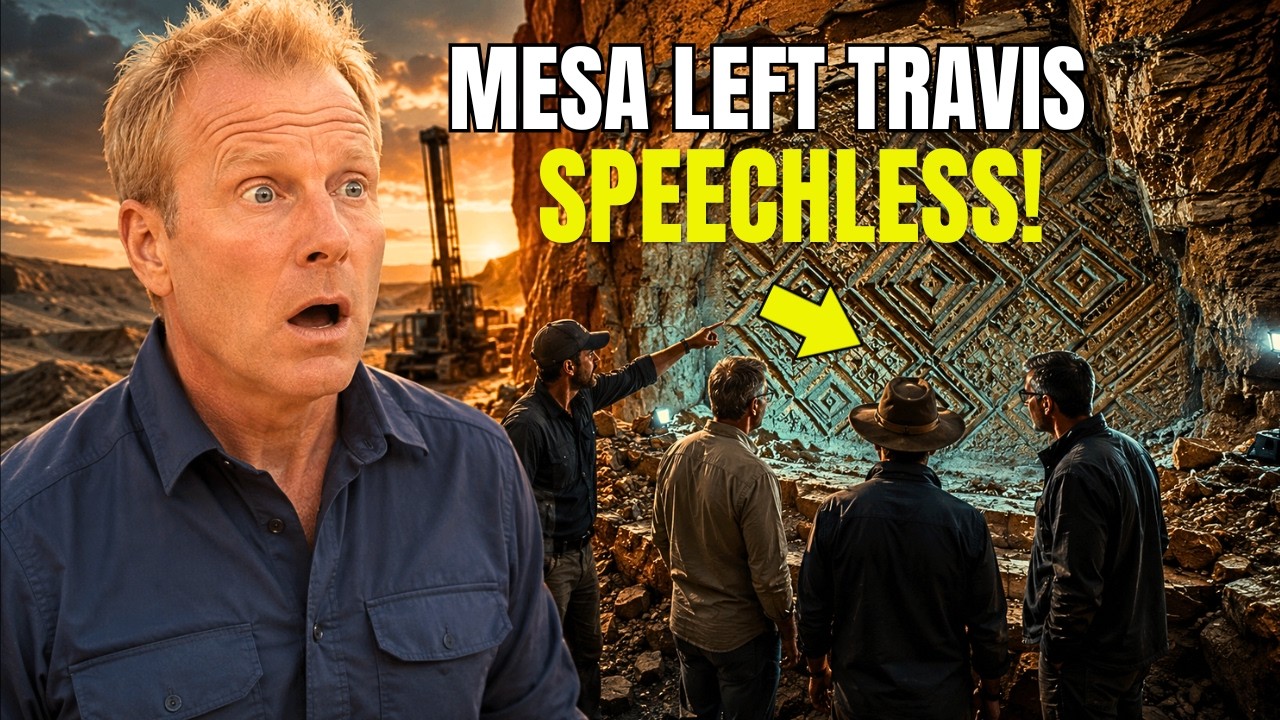
The mesa is no longer simply containing something. It begins to feel as though it is keeping something in order. This is the point at which Travis Taylor’s reaction matters most. The value of a measured reaction is that it helps the audience understand scale. In stories about the unexplained, not every astonished face means the same thing.
Television can exaggerate surprise until surprise becomes meaningless. But the more experienced the observer, the more revealing it is when that observer no longer finds the easy answer persuasive.
Taylor’s importance in this narrative does not rest on the fact that he was stunned. It rests on why a person in his position might be stunned at all. A technically trained investigator can live comfortably with ambiguity for a long time. Most data in difficult fieldwork is imperfect. Instruments fail. Conditions interfere. Human beings overread what they want to see. A serious researcher learns to absorb frustration without surrendering to fantasy. That is why genuine shifts in demeanor matter. When someone accustomed to strange readings stops treating them as isolated nuisances and begins to see them as connected, that emotional change becomes part of the evidence. Not proof of what is underground, but proof that the case for ignoring it has become weaker. The later recap of the ranch investigation offered another useful detail in this regard. Dr. Jan Frank speaking about instrumentation and data reportedly said he had done this kind of work in 108 countries around the world and that Skinwalker Ranch produced more frustration than any site he had encountered. That statement is valuable not because it confirms extraordinary conclusions but because it frames the ranch as a place where data itself becomes difficult to tame. Frustration is not an argument, but expert frustration repeated over time can signal a site where the normal rules of field confidence begin to break down.
And once that happens, even older observations acquire new tension.
Consider what the investigators had already seen around the mesa and the nearby areas. Earlier episodes had explored helicopter experiments, dropped GPS canisters, laser tests, rockets, and cameras trained on the sky. In one account, canisters seem to behave oddly between altitude and ground as if redirected away from the wind. In another, an orblike object was seen ascending beside a laser beam before vanishing. Elsewhere, a rocket explosion coincided with a strange symmetrical cloud-like anomaly captured by high-speed imaging. Some of these events were associated more closely with the triangle than the mesa itself, but that is part of what makes the ranch difficult to separate into neat zones.
The features may be geographically distinct, yet the atmosphere of recurrence links them psychologically.
The investigators are not merely dealing with one odd location. They are working inside a landscape that appears again and again to produce events resistant to normal expectation. The mesa stands at the center of that mood because it combines two categories of mystery at once. Above ground, it has been implicated in reports of lights, heat, and motion. Below ground, it has resisted drilling and produced anomalous readings. That combination is what gives the hidden pattern its force. If the internal structure of the mesa were entirely isolated from the phenomena around it, the story would still be intriguing. But if the buried arrangement and the aerial behavior belong in some way to the same larger system of anomalies, then the mystery stops feeling static. it begins to feel interactive. That possibility must be handled carefully. Nothing in the available evidence proves that what is under the mesa causes what appears above it. The disciplined approach is not to declare connection where only correlation exists. Yet disciplined inquiry also demands that repeated correlation not be ignored simply because it is uncomfortable. If objects on camera seem drawn toward the mesa, if thermal irregularities appear on or above it, if drilling and radar reveal internally repeated anomalies, then at the very least the mesa deserves to be treated as more than a scenic wall of rock. It becomes a candidate for coherence in a place better known for disorder. And coherence is exactly what makes this case so haunting. A single buried object invites excavation.
A pattern invites interpretation.
Once investigators begin to suspect pattern, they are forced into a more demanding intellectual position. They can no longer ask only what is there.
They must ask what kind of process could have put it there. Could nature account for it? Possibly. Geology is capable of surprising arrangements and underground formations can produce shapes that look meaningful before they are understood.
Pressure, collapse, mineral banding, erosion, and ancient shifts in the earth can all create structure where human eyes see intention. A cautious script must grant that possibility first.
Because mature investigation begins with the grounded answer, not the glamorous one. But grounded answers must be sufficient, not merely available. That is the problem. A natural explanation may account for hardness, for voids, for irregular density, perhaps even for curved resistance. Yet, does it adequately explain repeated targets at different depths, clearly metallic anomalies in later scans, past metal fragments in drilling spoils, and a history of deflection that made the team infer a domelike form? Perhaps, but perhaps is not the same as enough. Then there is the human explanation. Could the messa conceal remnants of earlier activity? a hidden excavation, old industrial debris, a blasting event, a buried structure. The demolition expert once consulted by the team reportedly suggested that the boulder configuration near the alleged cave entrance did not seem entirely natural, but more like the result of a purposeful explosion. That is a serious thought and a sobering one.
Human beings have always been capable of leaving behind secrets that later generations mistake for impossibility.
An older audience will appreciate this possibility because history is full of forgotten labor, concealed sites, improvised technology, and places altered for reasons that vanish with time. [clears throat] And yet the human explanation also strains under the wider pattern. If the mesa contains the remains of an earlier intervention, does that fully explain the reported aerial incidents? Does it explain the recurring sense that activity gathers at the same place? Does it account for metallic readings deep inside the formation alongside years of anomalous events above it? It may explain part of the story, but again, part is not the same as whole. That is the tension. Honest investigators must live with. The grounded explanations are never to be mocked. They are to be tested until they either hold or fail. But each grounded explanation must carry the full burden of the evidence, not merely the least inconvenient portion of it. A natural structure must explain the deflection, the fragments, the repeated anomalies, and the persistent return of the mesa.
In related observations, a human intervention must explain not only what was buried, but why it seems wrapped in so many other strange circumstances. The burden of interpretation grows heavier with every added layer. And in that weight, the mystery becomes more serious, not less. It is also here that language matters. Responsible narration should avoid giving the audience a false sense of closure simply because a plausible theory has been named.
Plausibility is not resolution. Many things are plausible until one asks them to explain every stubborn detail. That is why the most credible approach is to let each theory stand for a moment in the light, then turn it slowly and look at its blind side. What remains unaccounted for after that process is often where the real mystery lives. That leaves the possibility investigators are often most reluctant to name directly that the buried arrangement inside the mesa may be intentional in a sense not easily reduced to geology or forgotten local history. This is where responsible narration must slow down rather than accelerate. No serious observer should leap from unexplained pattern to extraordinary certainty. But neither should the extraordinary possibility be banished simply because it is unsettling. If enough evidence accumulates to suggest structure, and if ordinary explanations continue to explain only fragments, then mystery earns the right to remain mystery.
Perhaps that is why Travis Taylor’s reaction resonates. It captures a threshold, not the threshold between ignorance and proof, but the threshold between easy dismissal and difficult attention. Once crossed, the entire story feels different. The mesa is no longer just the place where drilling got strange. It becomes the place where repeated evidence began to hint at order and order changes memory. Suddenly, earlier moments on the ranch acquire a different tone. The reports of an orb entering the mesa no longer sound like a disconnected curiosity. The thermal anomaly on the boulders above a ceremonial performance no longer feels entirely isolated. The larger ranch with its lasers, signal drops, redirected canisters, and unexplained aerial events starts to resemble an environment circling around a concealed center. Even later, details from outside the mesa itself begin to contribute to the atmosphere. In the same recent recap that discussed new borehole anomalies, the investigators also described a thermal drone losing signal at the boundary of what they call the bubble and an abandoned homestead showing a heat signature so intense it looked, in one observer’s words, as if a furnace were operating inside a structure that should have held nothing of the kind. No single piece of that belongs exclusively to the mesa. But together they reinforce a central discomfort. At Skinwalker Ranch, different instruments, different locations, and different experimental approaches keep producing answers that do not settle. That may be the most important emotional truth in the story.
The investigators are not haunted because they know what the mesa contains. They are haunted because they keep getting close enough to suspect that it contains something coherent while never getting close enough to say exactly what that coherence means. Even the supporting details from recent fieldwork contribute to that sensation.
when a thermal drone reportedly lost signal as it reached the boundary of the bubble. The incident served as yet another reminder that data on this ranch does not always behave obediently. When observers described an abandoned homestead glowing with heat, as though a furnace were running inside a structure that should have contained no such source, the event deepened the sense that the ranch does not present its irregularities one at a time. It presents them in clusters almost as if each unanswered question arrives carrying the shadow of another. That is not proof of a unified cause, but it is precisely the sort of recurring pressure that makes investigators less willing to dismiss the mesa as a local curiosity.
By the time a hidden pattern is suspected within the rock, the audience is no longer being asked to care about one isolated underground anomaly. They are being asked to consider whether the mesa sits inside a wider field of related disturbances. Some above ground, some below, some visual, some instrumental, some physical, some psychological.
That broader frame gives the buried pattern its full dramatic force. It is not only that something may be arranged inside the mesa. It is that the arrangement may belong to a place already behaving as though buried order and surface phenomena are somehow aware of one another. For many people, uncertainty is an unsatisfying ending.
For serious investigation, uncertainty is often the most honest one. The dignity of this mystery lies in its refusal to resolve on command. Every time the team pushes deeper through rock, through data, through old assumptions, the mesa seems to answer only enough to sharpen the next question. If the anomalies at 30 ft, 80 ft, and 290 ft are all part of the same concealed arrangement, what is the arrangement for? If the metallic signatures are accurate, how did that material come to rest where it now appears? If earlier drilling really did scrape fragments from something below, what surface was touched but never penetrated? And if objects in the air have repeatedly seemed to interact with the mesa, then is the rock face hiding more than matter? Could it be hiding function? That final question is where the story becomes genuinely haunting.
Not because it proves anything but because it alters the scale of imagination required. A hidden object is one thing. A hidden pattern is another.
A pattern implies sequence, intention, architecture, or at the very least a repeated process that is left behind more order than chance should comfortably produce. And once that possibility enters the mind, the ranch is no longer merely a place of incidence. It becomes a place of design, whether natural, human, or something still beyond naming. For an older audience, this kind of mystery carries a particular power because it invites contemplation rather than shock. It asks us to consider how often the world first reveals its deeper secrets, not through spectacle, but through inconvenient consistency. A note that repeats, a signal that returns, a piece of data that refuses to stay alone. In that sense, the mesa is not frightening because it is loud. It is frightening because it is patient. It has allowed the investigators to circle it for years, to drill into it, to scan it, to argue around it, to collect fragments, images, and anomalies without fully entering the heart of the matter. And now with the suggestion of repeated internal features, with metallic targets appearing at different depths, and with experienced observers reacting less like performers and more like people confronting an uncomfortable pattern, the mystery seems to have crossed an invisible threshold. Not into certainty, into seriousness.
That may be the true significance of what happened. The buried question inside the mesa did not suddenly become solved. It became harder to dismiss. And sometimes that is the more important event. In science, in history, and in the long human habit of mistaking mystery for noise, the turning point often comes when a problem stops looking random. When scattered clues, imperfect on their own, begin to align just enough to challenge the comfort of coincidence.
If that is what the team has found inside the mesa, then the implications stretch in several directions at once.
Scientifically, the case demands better mapping, more precise imaging, more careful testing, and the discipline to separate signal from suggestion.
Historically, it opens the possibility that the mesa may contain evidence of hidden intervention, forgotten activity, or something buried with intent.
Emotionally, it asks a more intimate question. How should we respond when a landscape begins to look as though it is concealing order where no order should be? Perhaps the most responsible answer is also the most unsettling one. We respond by looking longer. By admitting what we do not know, by resisting both easy disbelief and easy belief, by understanding that mystery becomes most powerful, not when it overwhelms reason, but when it survives reasons best efforts to contain it. That is why Travis Taylor’s stunned moment lingers.
Not because it announces a conclusion, but because it marks the instant when evidence may have nudged a careful mind into a more uncomfortable category of thought. Not impossible, not proven, but patterned. And once a mystery begins to show pattern, it changes its relationship to everyone who studies it.
The observer is no longer waiting for a single dramatic revelation. The observer is listening for repetition, watching for alignment, returning almost reluctantly to the same place because the place has begun to answer in a language more structured than chance.
The mesa still keeps its center to itself. The instruments have not reached far enough. The rock has not yielded fully. The deeper meaning of those anomalies remains suspended between geology, history, and something more elusive. But the story has changed all the same. Beneath the stone, beneath the debris, beneath the years of rumor and experiment, the investigators may have glimpsed not just a hidden thing, but a hidden order. And if that order is real, then the most unsettling possibility is not simply that something is buried inside the mesa. It is that the mesa may have been trying in its own silent way to repeat the truth for years until someone finally noticed the pattern.