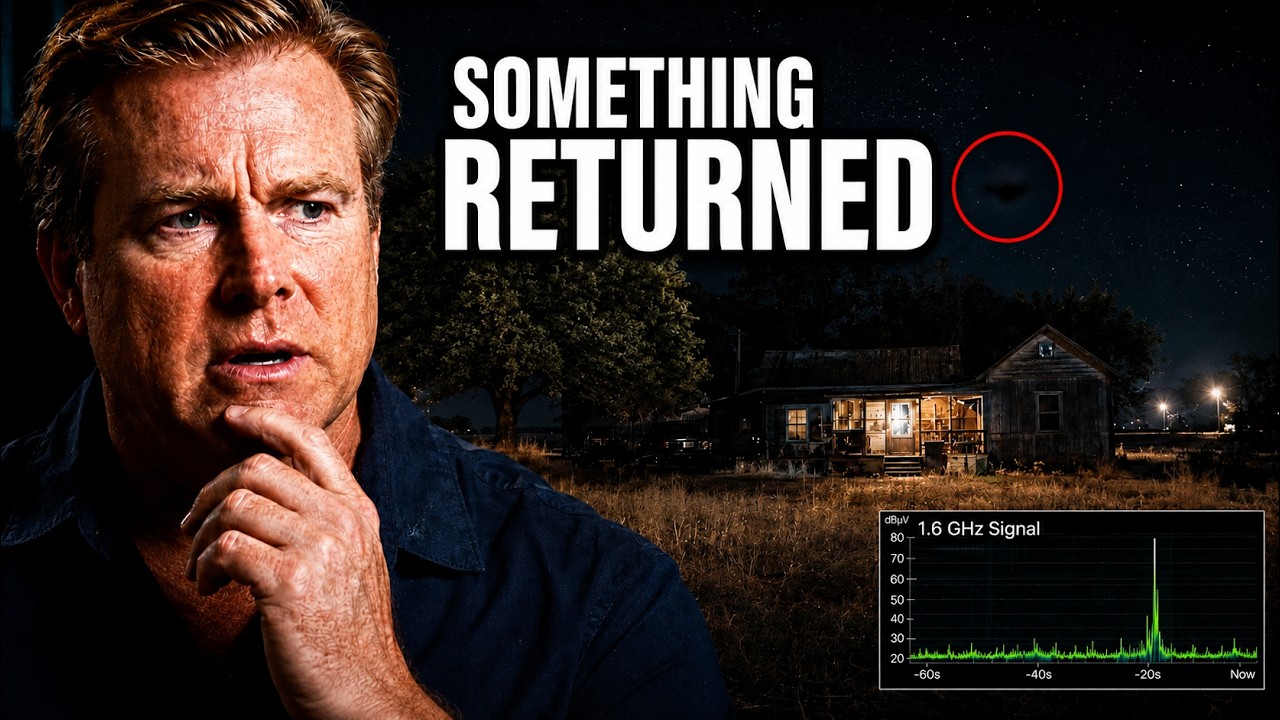
When Travis Taylor reviewed what happened at Homestead 2, the disturbing part was not one strange image.
It was how many different records pointed back to the same place.
A thermal camera logged a temperature drop with no explanation.
A laser scanner caught an anomaly hovering above the tree line.
And separately, a signal detector flagged a spike at the exact same moment. Three instruments, three technologies, one location.
A single blurry photo is easy to dismiss, but footage, data, and a second clue lining up on the same timestamp is a different problem. The kind that made even Travis Taylor stop talking and start reading the numbers. A strange image can be dismissed. A strange image during a signal event is harder to ignore. Before Travis Taylor calls anything unexplained, he runs it through a filter. The same filter every trained investigator uses, and the one most viral clips skip entirely. First question, is it a camera error? Dead pixels, sensor noise, compression artifacts.
Thermal and night vision footage is full of them, and most anomalies die right here. Second question, is it a reflection?
Glass, water, metal, even dust on a lens can throw back a shape that looks solid until you check the angle. Third, environmental interference. Heat shimmer, insects, birds, weather.
Homestead 2 sits in open terrain, so this list is long. Fourth, equipment issue. Loose cables, firmware glitches, a sensor drifting out of calibration.
Only when all four come up empty does Travis let the word anomaly stay on the table.
He doesn’t chase mysteries. He tries to kill them first.
But the first problem appeared before anyone could reduce it to one simple glitch. Here’s what actually showed up on the monitors at Homestead 2.
During the ceremony, the FLIR thermal camera reported it picked up a hot spot.
A small, defined heat signature with no clear source. No person standing there.
No engine. No fire. Nothing in the environment that should produce heat in that exact shape. It appeared gradually, held its form for several seconds, and then faded.
At almost the same time, the metaframe system, the ranch’s higher resolution optical layer, flagged an odd feature hovering just above the same spot.
Not a clean shape.
Not something you could point to and say, “That’s a craft.” Or, “That’s a person.” Just an unusual density in the frame that hadn’t been there moments before, and that behaved differently from the surrounding air and light.
Both readings lined up with the ceremony’s timing almost perfectly.
As the ritual began, the anomaly appeared. As the ritual wound down, it disappeared.
Taken on its own, this is the kind of footage that’s difficult to dismiss, but far from conclusive.
A thermal hot spot can have a dozen explanations.
An optical artifact can, too.
Visual data like this, by itself, is not proof of anything.
It’s a flag, not a conclusion, which is exactly why the team didn’t stop at the image.
They went back to replay it.
By itself, that would still leave room for doubt.
Then Travis noticed the signal. The footage alone would have been a strange clip in a long file of strange clips.
What changed things was what Travis Taylor found next.
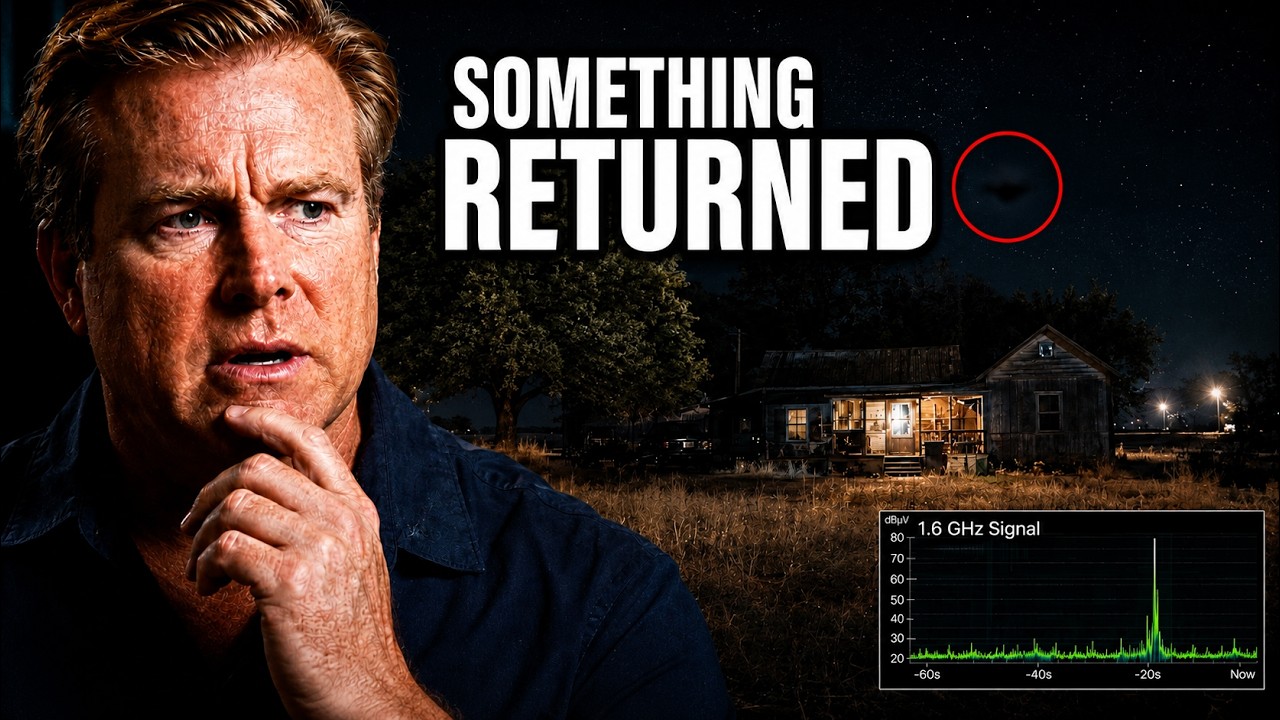
While reviewing the data logs from the same window, Travis noticed a signal reading at 1.6 GHz, a frequency close to the band used by GPS satellites, and one the team had flagged before during other anomalies on the property.
This time, it wasn’t just present.
It was strong enough to direction find.
Using a directional antenna, the team traced the signal back toward its source.
The bearing pointed toward Homestead 2, the same structure where the thermal hotspot and the metaframe anomaly had just been recorded.
This is the detail that moved the case out of interesting footage territory.
A visual anomaly can be a trick of light, a sensor error, or reflection.
A signal is different. It’s measurable, directional, and repeatable in a way an image isn’t. And this one wasn’t coming from a satellite overhead.
It was coming from the ground, from one specific location.
The question was no longer only what appeared above Homestead 2.
It was why a familiar signal seemed to come from the same area.
Now the investigation was no longer about one image.
It was about a pattern forming around Homestead 2. Before going any further, it’s worth asking the obvious question.
Could [snorts] this just be noise?
Thermal cameras misfire.
Reflections trick sensors.
Equipment drifts out of calibration.
Especially gear that’s been running for hours in the field.
And signal interference is common enough that a 1.6 GHz blip on its own wouldn’t raise many eyebrows.
So, take the strongest version of that explanation and test it.
Say the FLIR hotspot was thermal noise.
A sensor artifact, nothing more.
That alone could explain the footage.
Say the metaframe anomaly was a reflection or a lens artifact.
That alone could explain the image.
Say the 1.6 GHz reading was ordinary signal interference, unrelated to anything on the ranch.
That alone could explain the data.
The problem isn’t any one of those explanations.
Each one, by itself, is plausible.
The problem is that all three showed up on different systems using different technology pointed at the same structure during the same short window.
One glitch is a coincidence.
Three separate systems glitching in the same direction at the same time is a much harder case to make. That is where Travis Taylor’s analysis became important. This is the part that actually got to Travis Taylor.
Not the footage, not the signal, but the shape they made when placed side by side.
Travis Taylor was not disturbed by one strange reading.
He was disturbed by the way separate pieces of evidence started pointing back toward Homestead 2.
Run through it the way he did, the thermal camera and the metaframe system don’t share hardware.
They don’t process data the same way, and they don’t fail in the same way.
For both to register an anomaly at the same location in the same short window is already an unlikely overlap.
Then add the signal.
A 1.6 GHz reading, direction found back to that exact structure, recorded on equipment that has nothing to do with either camera system.
Three independent technologies, three separate failure modes, if you want to call them failures, one location, one timestamp.
That’s not how noise usually behaves.
Noise is random.
It doesn’t organize itself around a single 19th century structure on a 512 acre property.
A camera glitch here and an equipment error there is normal.
A camera glitch, an optical anomaly, and a signal return all converging on Homestead 2 in the same ceremony is a pattern.
And patterns are exactly what a trained investigator is trained not to ignore.
It wasn’t the strangeness of any one reading.
It was the coincidence of all of them landing in the same place.
But Homestead 2 already had a history that made this moment feel heavier.
Homestead 2 isn’t just another spot on the map.
It’s one of the most consistently active locations on the entire property.
Long before this ceremony, during the ranch’s earlier Bigelow era research, investigators were already logging strange activity in this exact area.
Unexplained lights, equipment behaving oddly, reports that didn’t fit any conventional explanation.
Later teams kept coming back to it for the same reason.
Whatever was happening on the ranch seemed to concentrate here more than almost anywhere else.
Multiple investigations over the years have treated Homestead 2 as a kind of focal point.
Not because anyone decided it should be, but because the data kept steering them there.
Cameras pointed elsewhere would go quiet.
Cameras pointed at Homestead 2 wouldn’t.
That history is why this new activity landed differently.
This wasn’t a random field or an unremarkable outbuilding picking up a stray reading.
It was the one location on 512 acres with a documented pattern of producing exactly this kind of anomaly going back years before Travis Taylor ever set foot on the property.
So when new activity appeared there again, it did not feel isolated. Up to this point, everything strange had happened to equipment.
The next development made it personal.
As part of the same monitoring effort, a team member was wired into an EEG headset. Standard gear used to track brainwave activity during the ceremony.
Partway through, the connection started acting up.
Not a dead battery, not a loose wire.
The signal kept dropping and returning in a way the equipment techs couldn’t immediately explain.
Then came the detail that connected it to everything else.
While the EEG was misbehaving, the same 1.6 GHz reading that had been traced to Homestead 2 showed up again.
This time overlapping with a spike in higher frequency brainwave activity on the headset itself.
This is where the case stopped being only about cameras and sensors.
A thermal anomaly is unsettling.
A signal return is unsettling.
But a human nervous system showing unusual activity at the exact moment a known signal reappears in the same location is a different category of problem.
One that isn’t easily reduced to a hardware issue.
Nobody was claiming mind control or possession.
That’s not how a careful investigator frames it.
But an EEG malfunctioning in sync with an external signal at a site already tied to two other anomalies is not something you wave off as a coincidence.
That left only three explanations.
And each one had a problem. Strip the case down and there are really only three explanations on the table. Theory one, equipment behavior. FLIR sensors drift. EEG headsets lose contact.
Metaframe systems misread light. Every piece of gear used that night has documented limitations and any one of them alone could misfire.
This explains individual glitches but not why four separate systems glitch together at the same location on the same timeline. Theory two, environmental or electromagnetic interference.
Homestead two sits in a region with a known history of odd electromagnetic behavior.
Something in the ground, the geology, or the air could be disrupting electronics broadly.
This explains why multiple devices might act up in the same area. It doesn’t explain why the disruption tracks so precisely with the ceremony itself appearing and fading almost on cue.
Theory three, an unknown ranch phenomenon. Something actually present doing something to both equipment and the human nervous system.
This fits the pattern most completely.
But it’s also the theory with the least hard evidence behind it.
And the one a scientist is trained to resist reaching for first.
Each theory explains part of the case.
None explains the full sequence cleanly.
And that is why Travis could not give the simple answer everyone wanted. Take any single piece of this case on its own, and Travis Taylor could question it.
A thermal image can be a glitch.
A signal can be interference.
An EEG dropout can be a loose connection. Even the timing could in isolation be written off as coincidence.
What he couldn’t do was dismiss all of it at once.
Four independent systems, four different failure points, all converging on one structure in one narrow window of time.
That’s the part that doesn’t resolve.
Not the footage, not the signal, the pattern.
The real question is not whether this proves paranormal activity.
The question is why Skinwalker Ranch keeps producing events that become harder to explain when more instruments are watching.
That’s the mystery Travis Taylor is still working on.
Do you think this was real paranormal activity?
Or could Homestead 2 be affected by some kind of electromagnetic interference?
Comment your theory below because this is one of those Skinwalker Ranch moments where one piece of footage does not tell the whole story.